


Page 196 - (DK Eyewitness) Travel Guide - Brittany
P. 196
194 BRIT T AN Y REGION B Y REGION
Exploring Vannes Many of the houses in the area
around the square have unusual
The history of Vannes goes back to Roman times, when it decoration. The house at No. 13
was known as Darioritum. In the 5th century, it was a diocese Rue Salomon has animal carvings
and, in the Middle Ages, a city of major importance. Vannes and, on the corner of Rue Noé,
expanded during the 14th century, when it became the is the famous inn sign in the form
of “Vannes et sa Femme”, the
capital of Brittany. As a university town, an administrative couple who ran the tavern.
centre and the capital of the Morbihan, it is again expanding In the 17th century, when the
rapidly today. The city also attracts large numbers of Breton parliament was exiled in
sightseers and holiday-makers. Vannes, many fine granite or
stone town houses (hôtels) were
built here. The Hôtel de Lannion,
in Impasse de la Psalette, flanked
by a projecting turret, was once
the residence of the governors of
Vannes and Auray. The Hôtel de
Limur, in Rue Thiers, with a Neo-
Classical façade, is a three-storey
residence with a courtyard
and a garden.
E Musée de la Cohue
9 & 15 Place St-Pierre. Tel (02) 97
01 63 00. Open Jun–Sep: daily pm;
Oct–May: Tue–Sun pm.
Closed public holidays. &
This museum is laid out in a
restored covered market (cohue)
whose origins go back to the
13th century. While market stalls
occupied the ground floor, the
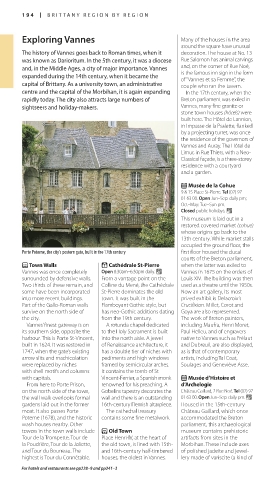
Porte Poterne, the city’s postern gate, built in the 17th century first floor housed the ducal
courts of the Breton parliament,
P Town Walls R Cathédrale St-Pierre when the latter was exiled to
Vannes was once completely Open 8:30am–6:30pm daily. & Vannes in 1675 on the orders of
surrounded by defensive walls. From a vantage point on the Louis XIV. The building was then
Two thirds of these remain, and Colline du Mené, the Cathédrale used as a theatre until the 1950s.
some have been incorporated St-Pierre dominates the old Now an art gallery, its most
into more recent buildings. town. It was built in the prized exhibit is Delacroix’s
Part of the Gallo-Roman walls Flamboyant Gothic style, but Crucifixion. Millet, Corot and
survive on the north side of has neo-Gothic additions dating Goya are also represented.
the city. from the 19th century. The work of Breton painters,
Vannes’ finest gateway is on A rotunda chapel dedicated including Maufra, Henri Moret,
its southern side, opposite the to the Holy Sacrament is built Paul Helleu, and of engravers
harbour. This is Porte St-Vincent, into the north aisle. A jewel native to Vannes such as Frélaut
built in 1624. It was restored in of Renaissance architecture, it and Dubreuil, are also displayed,
1747, when the gate’s existing has a double tier of niches with as is that of contemporary
arrow slits and machicolation pediments and high windows artists, including Tal Coat,
were replaced by niches framed by semicircular arches. Soulages and Geneviève Asse.
with shell motifs and columns It contains the tomb of St
with capitals. Vincent-Ferrier, a Spanish monk E Musée d’Histoire et
From here to Porte Prison, renowned for his preaching. A d’Archelogie
on the north side of the town, Gobelins tapestry decorates the Château Gaillard, 2 Rue Noé. Tel (02) 97
the wall walk overlooks formal wall and there is an outstanding 01 63 00. Open Jun–Sep: daily pm. &
gardens laid out in the former 16th-century Flemish altarpiece. Housed in the 15th-century
moat. It also passes Porte The cathedral treasury Château Gaillard, which once
Poterne (1678), and the historic contains some fine metalwork. accommodated the Breton
wash houses nearby. Other parliament, this archaeological
towers in the town walls include P Old Town museum contains prehistoric
Tour de la Trompette, Tour de Place Henri-IV, at the heart of artifacts from sites in the
la Poudrière, Tour de la Joliette, the old town, is lined with 15th- Morbihan. These include axes
and Tour du Bourreau. The and 16th-century half-timbered of polished jadeite and jewel-
highest is Tour du Connétable. houses, the oldest in Vannes. lery made of variscite (a kind of
For hotels and restaurants see pp228–9 and pp241–3
194-195_EW_Brittany.indd 194 11/3/16 12:48 PM

