


Page 75 - (DK Eyewitness) Travel Guide - Brittany
P. 75
ILLE-E T-VILAINE 73
The old town (Bourg Vieil), at
the foot of the castle, is filled
with old timber-framed houses,
particularly in Place du Marchix
and Rue de Lusignan. The new
town (Bourg Neuf) overlooks the
castle. Gutted by fire on several
occasions, it was re built in the
18th century.
A timber-framed building in
Rue Nationale, with a porch and
corbelling typical of 15th–16th-
century houses in Upper Brittany,
contains the Musée Emmanuel-
de-La-Villéon. As well as 70
paintings dating from the 17th
and 18th centuries, the museum
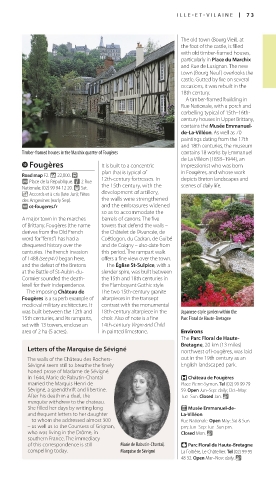
Timber-framed houses in the Marchix quarter of Fougères contains 18 works by Emmanuel
de La Villéon (1858–1944), an
0 Fougères It is built to a concentric Impressionist who was born
plan that is typical of in Fougères, and whose work
Road map F2. * 22,800. £
@ Place de la République. n 2 Rue 12th-century fortresses. In depicts Breton landscapes and
Nationale; (02) 99 94 12 20. ( Sat. the 15th century, with the scenes of daily life.
_ Accords et à cris (late Jun); Fêtes development of artillery,
des Angevines (early Sep). the walls were strengthened
∑ ot-fougeres.fr and the embrasures widened
so as to accommodate the
A major town in the marches barrels of canons. The five
of Brittany, Fougères (the name towers that defend the walls –
derives from the Old French the Châtelet de l’Avancée, de
word for “ferns”) has had a Coëtlogon, du Cadran, de Guibé
chequered history over the and de Coigny – also date from
centuries. The French invasion this period. The rampart walk
of 1488 (see p47) began here, offers a fine view over the town.
and the defeat of the Bretons The Église St-Sulpice, with a
at the Battle of St-Aubin-du- slender spire, was built between
Cormier sounded the death- the 15th and 18th centuries in
knell for their independence. the Flamboyant Gothic style.
The imposing Château de The two 15th-century granite
Fougères is a superb example of altarpieces in the transept
medieval military architecture. It contrast with the monumental
was built between the 12th and 18th-century altarpiece in the Japanese-style garden within the
15th centuries, and its ramparts, choir. Also of note is a fine Parc Floral de Haute-Bretagne
set with 13 towers, enclose an 14th-century Virgin and Child
area of 2 ha (5 acres). in painted limestone. Environs
The Parc Floral de Haute-
Bretagne, 20 km (13 miles)
Letters of the Marquise de Sévigné northwest of Fougères, was laid
The walls of the Château des Rochers- out in the 19th century as an
Sévigné seem still to breathe the finely English landscaped park.
honed prose of Madame de Sévigné.
In 1644, Marie de Rabutin-Chantal + Château de Fougères
married the Marquis Henri de Place Pierre-Symon. Tel (02) 99 99 79
Sévigné, a spendthrift and liber tine. 59. Open Jun–Sep: daily; Oct–May:
After his death in a duel, the Tue–Sun. Closed Jan. &
marquise withdrew to the chateau.
She filled her days by writing long E Musée Emmanuel-de-
and frequent letters to her daughter La-Villéon
– to whom she addressed almost 300 Rue Nationale. Open May: Sat & Sun
– as well as to the Countess of Grignan, pm; Jun–Sep: Tue–Sun pm.
who was living in the Drôme, in Closed Mon. &
southern France. The immediacy
of this correspon dence is still Marie de Rabutin-Chantal, Y Parc Floral de Haute-Bretagne
compelling today. Marquise de Sévigné La Foltière, Le Châtellier. Tel (02) 99 95
48 32. Open Mar–Nov: daily. &
072-073_EW_Brittany.indd 73 11/3/16 12:42 PM

