


Page 78 - (DK Eyewitness) Travel Guide - Brittany
P. 78
76 BRIT T AN Y REGION B Y REGION
t Dol-de-Bretagne which they are decorated are in Ages. At No. 17, the Maison
the Anglo-Norman Gothic style, des Petits-Palets, with carved
Road map E2. * 5,020. £ n 5
Place de la Cathédrale; (02) 99 48 15 and are similar to those in Romanesque arcades, is a
37. ( Sat. _ Folklore festival (last Salisbury Cathedral. rare example of French
Sun in Jul); Christmas market. A very expressive Scourging of 12th-century town architecture.
∑ pays-de-dol.com Christ can be seen in the north Opposite, a porch leads to
aisle, and in the north transept the Cour aux Chartiers, a
The religious capital of lies the splendid tomb of 15th-century courtyard.
Nominoë, king of Brittany Thomas James, bishop of Dol The Logis de la Croix Verte,
during the 9th century, Dol from 1482 to 1504. Dating from at No. 18, also dating from the
owes its prestige and prosperity the 16th century, with figures of 12th century, was once an inn
to its cathedral, which is one of classical inspiration, this tomb is run by the Knights Templar.
the finest examples of Gothic one of the earliest signs of the The Maison de la Guillotière, at
architecture in Brittany. Renaissance in Brittany. It was No. 27, has a porch supported
In about 548, St Samson, carved in the workshop of the on polygonal columns with
one of the seven monks who Florentine sculptor Jean Juste, carved capitals.
established Christianity in who also made the tomb of
Brittany, arrived from England Louis XII in St-Denis, near Paris. R Cathédrale St-Samson
and founded a monastery. A The 77 choir stalls are lit by an Place de la Cathédrale. Open daily.
town grew up around it and, outstanding 13th-century 8 Jul–Aug: daily. Concerts: Jul–Aug:
despite suffering repeated stained-glass window with Tue & Thu eve.
attacks by English-controlled medallion-shaped panels. Some E La Cathédraloscope
Normandy and from the kings of the stained-glass windows Place de la Cathédrale. Tel (02) 99 48
of France, it flourished and here are among the oldest 35 30. Open Apr–Sep: daily. Closed
enjoyed great prestige until in Brittany. Oct–Mar. &
1801. In 1793, it was the scene Using the most up-to-date
of bloody conflict between tech niques, La Cathédraloscope,
Chouan royalists and in the former bishop’s palace
Republicans (see p52). on Place de la Cathédrale, gives
The Cathédrale St-Samson a history of the cathedral’s
stands on the former site of a construction and the work of
Romanesque church that was the craftsmen involved, from
burned down by Jean sans Terre building techniques and skills
in 1203. The great 14th-century used, to the symbolism of
doorway on the south side is the decoration on the façade
finely decorated. The north side, and the making of the stained-
by contrast, faces the open glass windows.
countryside and has the The Promenade des Douves
appearance of a fortified wall. (Moat Walk), which passes
The interior is impressive behind the cathedral’s apse,
through its sheer size. In the follows the ramparts on the
nave, 93 m (305 ft) long, seven northern side of the town, The Menhir du Champ-Dolent, in the
spans of arches rise through from where there is a view “Field of Sorrow”
three tiers (an arcade, triforium of the marshes and of
arches and a clerestory), and the Mont-Dol. Grande-Rue-des- y Menhir du
crossing is crowned by a 20-m Stuart, with houses with pillared Champ-Dolent
(65-ft) high dome. The columns, porches, offers a glimpse of Dol
arches and stylized motifs with as it appeared in the Middle Road map E2. About 2 km (1 mile)
south of Dol-de-Bretagne on the
D795. Open daily. Open access.
Consisting of a single block
of granite 9.5 m (31 ft) high,
the Menhir du Champ-Dolent
is the tallest – and some
would say also the finest –
of Brittany’s standing stones.
According to legend, it fell
from the sky, separating
two warring brothers who
were locked in deadly battle.
It is this legend that accounts
for the name “Champ
Dolent”, meaning “Field
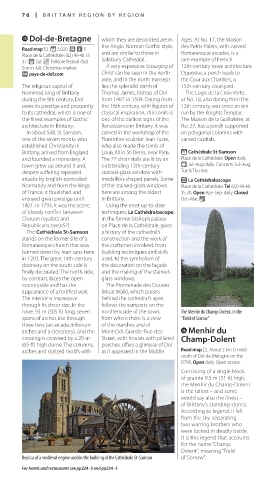
Replica of a medieval engine used in the building of the Cathédrale St-Samson of Sorrow”.
For hotels and restaurants see pp224–5 and pp234–5
076-077_EW_Brittany.indd 76 11/3/16 12:42 PM

