


Page 14 - BBC Wildlife Volume 36 #05
P. 14
WILD SPRING


                                            Let’s not sugar the pill: many of the   lessons this research has taught us, there
                 MIKE                       UK’s farmland species are in trouble,   may now be signs that we’re finally turning
              DILGER                        and it’s causing a drop in the diversity of   a corner towards more wildlife-friendly
                                            our countryside. The last 50 years have
                                                                                 farming methods.
            WILDLIFE                        seen unparalleled levels of agricultural   WHEN TO GO AND WHAT TO SEE
                                            intensification. On many arable farms
                                                                                 Timing your visit to farmland is vital –
                                            herbicides and pesticides have been liberally
        WATCHING                            used to massively increase crop yields, while   picking a nice day is crucial. While mornings
                                            hedgerows have been uprooted to make way
                                                                                 are undoubtedly best for birds, many
                                            for bigger, more efficient farm machinery.
                                                                                 mammals confine their activity to dawn
                  On farmland               Livestock herds have also grown in size    and dusk, particularly those found near
                                                                                 noisier and busier farms.
                                            over the same period and now require more
                                            space and feed, meaning wildlife is being   In such a potentially open landscape,
             Three quarters of Britain is   squeezed out even more.              you can easily stand out like a sore thumb,
            farmland, but much of it is      Following alarm bells sounded by    causing wildlife to run away. Using a car
           of little interest for wildlife…   environmentalists, scientific research has   as a mobile hide can be an effective means
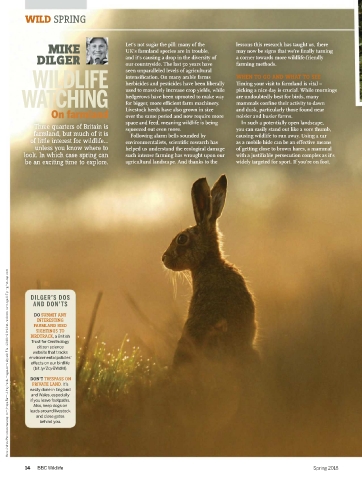
             unless you know where to       helped us understand the ecological damage   of getting close to brown hares, a mammal
         look. In which case spring can     such intense farming has wrought upon our   with a justifiable persecution complex as it’s
         be an exciting time to explore.    agricultural landscape. And thanks to the   widely targeted for sport. If you’re on foot,


    ng/naturepl.com  DILGER’S  DOS


    /2020VISION/naturepl.com; partr dge: D T p  AND DON’TS


             DO SUBMIT ANY
              INTERESTING
            FARMLAND BIRD
             SIGHTINGS TO
           BIRDTRACK, a British
            Trust for Ornithology
             citizen science
    Hare: Andrew Parkinson/naturepl.com; Hope Farm: A Hay/rspb- mages.com; sky ark: F G
            website that tracks
           environmental policies’
           efects on our birdlife
            (bit.ly/2qvBWdM).
           DON’T TRESPASS ON
            PRIVATE LAND. It’s
           easily done in England
            and Wales, especially
           if you leave footpaths.
            Also, keep dogs on
           leads around livestock
             and close gates
              behind you.


          14  BBC Wildlife                                                                                 Spring 2018

