


Page 15 - BBC Wildlife Volume 36 #05
P. 15
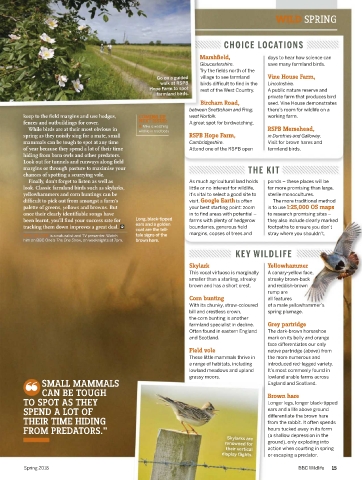
WILD SPRING
CHOICE LOCATIONS
Marshfield, days to hear how science can
M
G save many farmland birds.
Gloucestershire.
T
Try the fields north of the
Go on a guided v village to see farmland Vine House Farm,
walk at RSPB b Lincolnshire.
birds di cult to find in the
Hope Farm to spot r rest of the West Country. A public nature reserve and
farmland birds.
private farm that produces bird
B seed. Vine House demonstrates
Bircham Road,
betwe there’s room for wildlife on a
een Snettisham and Fring,
keep to the field margins and use hedges, CO MING UP west Norfolk. working farm.
M
T ISSUE:
fences and outbuildings for cover. NEXT A great spot for birdwatching.
O Mik e e is watching
While birds are at their most obvious in wildlife e in reed beds RSPB Mersehead,
spring as they noisily sing for a mate, small RSPB Hope Farm, in Dumfries and Galloway.
mammals can be tough to spot at any time Cambridgeshire. Visit for brown hares and
g
g
of year because they spend a lot of their time Attend one of the RSPB open farmland birds.
hiding from barn owls and other predators.
Look out for tunnels and runways along field
margins or through pasture to maximise your THE KIT
chances of spotting a scurrying vole.
Finally, don’t forget to listen as well as As much agricultural land holds ponds – these places will be
look. Classic farmland birds such as skylarks, little or no interest for wildlife, far more promising than large,
yellowhammers and corn buntings can be it’s vital to select a good site to sterile monocultures.
difficult to pick out from amongst a farm’s visit.Google Earth is often The more traditional method
palette of greens, yellows and browns. But your best starting point: zoom is to use 1:25,000 OS maps
once their clearly identifiable songs have in to find areas with potential – to research promising sites –
been learnt, you’ll find your success rate for Long, b black-tipped farms with plenty of hedgerow they also include clearly markeded
arly
mark
e
cle
ears an nd a golden
tracking them down improves a great deal. boundaries, generous field footpaths to ensure you don’t
s
r
c coat a re the tell-
gns of the
MIKE DILGER is a naturalist and TV presenter. Watch t tale sig margins, copses of trees and stray where you shouldn’t.
him on BBC One’s The One Show, on weeknights at 7pm. brown hare.
KEY WILDLIFE
Skylark Yellowhammer
This vocal virtuoso is marginally A canary-yellow face,
smaller than a starling, streaky streaky brown-baack
brown and has a short crest. and reddish-browwn
rump are
Corn bunting all features
With its chunky, straw-coloured of a male yellowhhammer’s
bill and crestless crown, spring plumage.
the corn bunting is another
farmland specialist in decline. Grey partridge
Often found in eastern England The dark-brown horseshoe
and Scotland. mark on its belly and orange
face diferentiates our only
Field vole native partridge (above) from
These little mammals thrive in the more numerous and
a range of habitats, including introduced red-legged variety.
lowland meadows and upland It’s most commonly found in
grassy moors. lowland arable farms across
SMALL MAMMALS England and Scotland.
` CAN BE TOUGH Brown hare
TO SPOT AS THEY Longer legs, longer black-tipped
SPEND A LOT OF ears and a life above ground
diferentiate the brown hare
THEIR TIME HIDING from the rabbit. It often spends
FROM PREDATORS.” hours tucked away in its form
(a shallow depression in the
Skylarks are
ground), only exploding into
renowned for
their vertical action when courting in spring
display flights. or escaping a predator.
Spring 2018 BBC Wildlife 15

