


Page 17 - BBC Wildlife Volume 36 #05
P. 17
WILD NEWS


         Q INSECTS
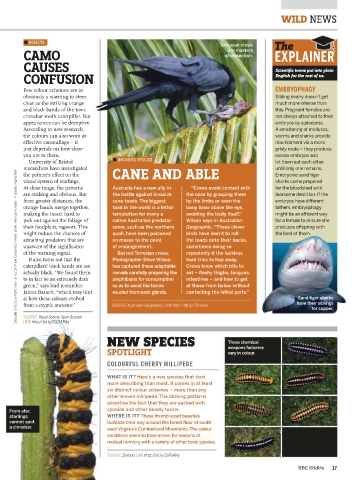
                                                                           Torresian crows    The
                                                                              are masters
         CAMO                                                                of dissection.     EXPLAINER
         CAUSES                                                                               6FLHQWLĶF WHUPV SXW LQWR SODLQ

         CONFUSION                                                                            (QJOLVK IRU WKH UHVW RI XV
         Few colour schemes are as                                                            EMBRYOPHAGY
         obviously a warning to steer                                                         Sibling rivalry doesn’t get
         clear as the striking orange                                                         much more intense than
         and black bands of the toxic                                                         this. Pregnant females are
         cinnabar moth caterpillar. But                                                       not always attached to their
         appearances can be deceptive.                                                        embryos by a placenta.
         According to new research,                                                           A smattering of molluscs,
         the colours can also work as                                                         worms and sharks provide
         effective camouflage – it                                                            nourishment via a more
         just depends on how close                                                            grisly route – they produce
         you are to them.                                                                     excess embryos and
           University of Bristol       Q INVASIVE SPECIES                                     let them eat each other
         researchers have investigated                                                        until only one remains.
       Caterpillar: Matt Cole/FLPA; crow: Ian Sutton/Flickr/CreativeCommons; shark: Mirko Zanni/Getty; millipedes: Virginia T ech
         the pattern’s effect on the   CANE AND ABLE                                          Embryonic sand tiger
         visual system of starlings.                                                          sharks come prepared
         At close range, the patterns   Australia has a new ally in  “Crows avoid contact with  for the bloodshed with
         are striking and obvious. But   the battle against invasive  the ooze by grasping them  fearsome dentition. If the
         from greater distances, the   cane toads. The biggest  by the limbs or even the      embryos have diferent
         orange bands merge together,   toad in the world is a lethal  bony brow above the eye,  fathers, embryophagy
         making the insect hard to     temptation for many a    avoiding the body itself,”    might be an e cient way
         pick out against the foliage of   native Australian predator -  Wilson says in Australian  for a female to ensure she
         their foodplant, ragwort. This   some, such as the northern  Geographic. “These clever  produces ofspring with
         might reduce the chances of   quoll, have been poisoned  birds have learnt to roll   the best of them.
         attracting predators that are   en masse to the point  the toads onto their backs,
         unaware of the significance    of endangerment.        sometimes doing so
         of the warning signal.          But not Torresian crows.  repeatedly if the luckless
           It also turns out that the   Photographer Steve Wilson  toad tries to hop away.
         caterpillars’ black bands are not   has captured these adaptable  Crows know which bits to
         actually black. “We found them   corvids carefully preparing the  eat – fleshy thighs, tongues,
         to in fact be an extremely dark   amphibians for consumption  intestines – and how to get
         green,” says lead researcher   so as to avoid the toxins  at these from below without
         James Barnett, “which may hint   exuded from neck glands.  contacting the lethal parts.”
         at how these colours evolved                                                                 Sand tiger sharks
         from a cryptic ancestor.”     SOURCE Australian Geographic LINK http://bit.ly/2Fmvvha       have their siblings
                                                                                                          for supper.
         SOURCE: Royal Society Open Science
         LINK http://bit.ly/2G2M3Mq

                                     NEW SPECIES                              These chemical
                                                                              weapons factories
                                     SPOTLIGHT                                vary in colour.
                                     COLOURFUL CHERRY MILLIPEDE

                                     WHAT IS IT? Here’s a new species that took
                                     more describing than most. It comes in at least
                                     six distinct colour schemes – more than any
                                     other known millipede. The striking patterns
                                     advertise the fact that they are packed with
    From afar,                       cyanide and other deadly toxins.
    starlings                        WHERE IS IT? These thumb-sized beauties
    cannot spot                      bulldoze their way around the forest floor of south-
    a cinnabar.                      west Virginia’s Cumberland Mountains. The colour
                                     variations seem to have arisen for reasons of
                                     mutual mimicry with a variety of other toxic species.

                                     SOURCE Zootaxa LINK http://bit.ly/2oPaANy
                                                                                                      BBC Wildlife  17

