


Page 64 - (DK Eyewitness) Travel Guide - Washington, DC
P. 64
62 W ASHINGT ON , DC AREA BY AREA
Exploring the National Gallery of Art
The National Gallery’s West and East Buildings are an unusual
pair. The West Building, designed by John Russell Pope, is stately
and Classical, with matching wings flanking its rotunda. Built
of Tennessee marble, it forms a majestic presence on the Mall.
Its collection is devoted to Western art from the 13th to the
early 20th century. The East Building, completed in 1978,
occupies a trapezoidal plot of land adjacent to the West
Building. The triangular East Building is as audacious as the
West one is conservative, but together they are harmonious.
The interior of the East Building is a huge, fluid space, with
galleries on either side housing works of modern art. The
Sculpture Garden, adjacent to the West Building, has a
fountain area that becomes an ice rink in winter.
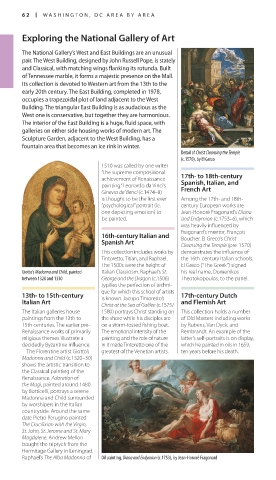
Detail of Christ Cleansing the Temple
(c.1570), by El Greco
1510 was called by one writer
“the supreme compositional
achievement of Renaissance 17th- to 18th-century
Spanish, Italian, and
painting.” Leonardo da Vinci’s
Ginevra de’ Benci (c.1474–8) French Art
is thought to be the first ever Among the 17th- and 18th-
“psych ological” portrait (ie. century European works are
one depicting emotion) to Jean-Honoré Fragonard’s Diana
be painted. and Endymion (c.1753–6), which
was heavily influenced by
Fragonard’s mentor, François
16th-century Italian and Boucher. El Greco’s Christ
Spanish Art
Cleansing the Temple (pre-1570)
This collection includes works by demonstrates the influence of
Tintoretto, Titian, and Raphael. the 16th-century Italian schools.
The 1500s were the height of El Greco (“The Greek”) signed
Giotto’s Madonna and Child, painted Italian Classicism. Raphael’s St. his real name, Domenikos
between 1320 and 1330 George and the Dragon (c.1506) Theotokopoulos, to the panel.
typifies the perfection of techni-
que for which this school of artists
13th- to 15th-century is known. Jacopo Tintoretto’s 17th-century Dutch
Italian Art Christ at the Sea of Galilee (c.1575/ and Flemish Art
The Italian galleries house 1580) portrays Christ standing on This collection holds a num ber
paintings from the 13th to the shore while his disciples are of Old Masters including works
15th centuries. The earlier pre- on a storm-tossed fishing boat. by Rubens, Van Dyck, and
Renaissance works of primarily The emotional inten sity of the Rembrandt. An example of the
religious themes illustrate a painting and the role of nature latter’s self-portraits is on display,
decidedly Byzantine influence. in it made Tintoretto one of the which he painted in oils in 1659,
The Florentine artist Giotto’s greatest of the Venetian artists. ten years before his death.
Madonna and Child (c.1320–30)
shows the artistic transition to
the Classical painting of the
Re naissance. Adoration of
the Magi, painted around 1480
by Botticelli, portrays a serene
Madonna and Child surrounded
by worshipers in the Italian
countryside. Around the same
date Pietro Perugino painted
The Crucifixion with the Virgin,
St. John, St. Jerome and St. Mary
Magdalene. Andrew Mellon
bought the triptych from the
Hermitage Gallery in Leningrad.
Raphael’s The Alba Madonna of Oil painting, Diana and Endymion (c.1753), by Jean-Honoré Fragonard
062-063_EW_Washington.indd 62 04/04/17 2:38 pm
Eyewitness Travel LAYERS PRINTED:
Flashmap follow-on template “UK” LAYER
(Source v1.4)
Date 5th November 2012
Size 125mm x 217mm

