


Page 102 - (DK Eyewitness) Travel Guide - The Netherlands
P. 102
100 A MSTERD A M
A Guide to Canal
House Architecture
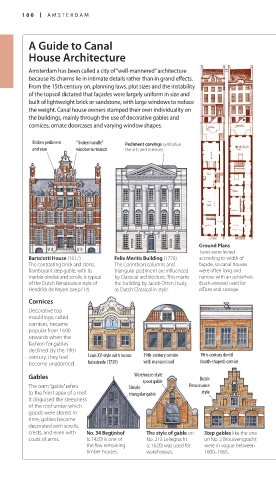
Amsterdam has been called a city of “well-mannered” architecture
because its charms lie in intimate details rather than in grand effects.
From the 15th century on, planning laws, plot sizes and the instability
of the topsoil dictated that façades were largely uniform in size and
built of lightweight brick or sandstone, with large windows to reduce
the weight. Canal house owners stamped their own individuality on
the buildings, mainly through the use of decorative gables and
cornices, ornate doorcases and varying window shapes.
Broken pediment “Broken handle” Pediment carvings symbolize
and vase window surrounds the arts and sciences.
Ground Plans
Taxes were levied
Bartolotti House (1617) Felix Meritis Building (1778) according to width of
The contrasting brick and stone, The Corinthian columns and façade, so canal houses
flamboyant step gable, with its triangular pediment are influenced were often long and
marble obelisk and scrolls, is typical by Classical architecture. This marks narrow, with an achterhuis
of the Dutch Renaissance style of the building by Jacob Otten Husly (back annexe) used for
Hendrick de Keyser (see p114). as Dutch Classical in style. offices and storage.
Cornices
Decorative top
mouldings, called
cornices, became
popular from 1690
onwards when the
fashion for gables
declined. By the 19th
century, they had Louis XV-style with ro coco 19th-century cornice 19th-century dentil
become unadorned. balustrade (1739) with mansard roof (tooth-shaped) cornice
Gables Warehouse-style Dutch
spout gable
The term “gable” refers Simple Renais sance
to the front apex of a roof. triangular gable style
It disguised the steepness
of the roof under which
goods were stored. In
time, gables became
decorated with scrolls,
crests, and even with No. 34 Begijnhof The style of gable on Step gables like the one No. 419 Singel has a
coats of arms. (c.1420) is one of No. 213 Leliegracht on No. 2 Brouwersgracht neck gable, a common
the few remaining (c.1620) was used for were in vogue between feature from 1640 to
timber houses. warehouses. 1600–1665. around 1840.
100-101_EW_Netherlands.indd 100 16/01/17 12:03 pm

