


Page 103 - (DK Eyewitness) Travel Guide - The Netherlands
P. 103
A GUIDE T O C ANAL HOUSE ARCHITEC TURE 101
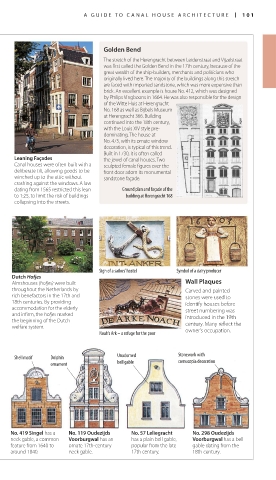
Golden Bend
The stretch of the Herengracht between Leidenstraat and Vijzelstraat
was first called the Golden Bend in the 17th century, because of the
great wealth of the ship-builders, merchants and politicians who
originally lived here. The majority of the buildings along this stretch
are faced with imported sandstone, which was more expensive than
brick. An excellent example is house No. 412, which was designed
by Philips Vingboons in 1664. He was also responsible for the design
of the Witte Huis at Herengracht
No. 168 as well as Bijbels Museum
at Herengracht 366. Building
continued into the 18th century,
with the Louis XIV style pre-
dominating. The house at
No. 475, with its ornate window
decoration, is typical of this trend.
Built in 1730, it is often called
Leaning Façades the jewel of canal houses. Two
Canal houses were often built with a sculpted female figures over the
deliberate tilt, allowing goods to be front door adorn its monumental
winched up to the attic without sandstone façade.
crashing against the windows. A law
dating from 1565 restricted this lean Ground plan and façade of the
to 1:25, to limit the risk of buildings building at Herengracht 168
collapsing into the streets.
Sign of a sailors’ hostel Symbol of a dairy producer
Dutch Hofjes
Almshouses (hofjes) were built Wall Plaques
throughout the Netherlands by Carved and painted
rich benefactors in the 17th and stones were used to
18th centuries. By providing identify houses before
accommodation for the elderly street numbering was
and infirm, the hofjes marked introduced in the 19th
the beginning of the Dutch century. Many reflect the
welfare system.
Noah’s Ark – a refuge for the poor owner’s occupation.
Shell motif Dolphin Unadorned Stonework with
ornament bell gable cornucopia decoration
No. 419 Singel has a No. 119 Oudezijds No. 57 Leliegracht No. 298 Oudezijds
neck gable, a common Voorburgwal has an has a plain bell gable, Voorburgwal has a bell
feature from 1640 to ornate 17th-century popular from the late gable dating from the
around 1840. neck gable. 17th century. 18th century.
100-101_EW_Netherlands.indd 101 16/01/17 12:03 pm

