


Page 130 - (DK Eyewitness) Travel Guide - The Netherlands
P. 130
128 A MSTERD A M
Exploring the Rijksmuseum
The Rijksmuseum is almost too vast to be seen in a single
visit. It is famous for owning probably the best collection
of Dutch art in the world, from early religious works to the
masterpieces of the Golden Age. However, the applied art
and sculpture sections, and the Asiatic artifacts, are equally
wonderful. In total, 8,000 pieces of art are on display in 80
wings. The selected pieces demonstrate the enormous
prosperity of Holland’s Golden Age in the 17th century.
Rembrandt’s The Night Watch is one of the masterpieces
on display.
These works are mostly
Dutch History religious, such as The Seven
The turbulent history of the Works of Charity (1504) by the
Netherlands is encapsulated Master of Alkmaar, Jan van
in this section. In the opening Scorel’s quasi-Mannerist Mary
room is the medieval altar Magdalene (1528) and Lucas
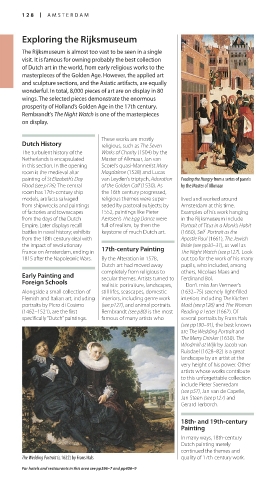
painting of St Elizabeth’s Day van Leyden’s triptych, Ador ation Feeding the Hungry from a series of panels
Flood (see p126). The central of the Golden Calf (1530). As by the Master of Alkmaar
room has 17th-century ship the 16th century progressed,
models, artifacts salvaged religious themes were super- lived and worked around
from shipwrecks and paintings seded by pastoral subjects; by Amsterdam at this time.
of factories and townscapes 1552, paintings like Pieter Examples of his work hanging
from the days of the Dutch Aertsen’s The Egg Dance were in the Rijksmuseum include
Empire. Later displays recall full of realism, by then the Portrait of Titus in a Monk’s Habit
battles in naval history; exhibits keystone of much Dutch art. (1660), Self- Portrait as the
from the 18th century deal with Apostle Paul (1661), The Jewish
the impact of revolutionary 17th-century Painting Bride (see pp30–31), as well as
France on Amsterdam, ending in The Night Watch (see p127). Look
1815 after the Napoleonic Wars. By the Alteration in 1578, out too for the work of his many
Dutch art had moved away pupils, who included, among
completely from religious to others, Nicolaes Maes and
Early Painting and secular themes. Artists turned to Ferdinand Bol.
Foreign Schools
realistic portraiture, landscapes, Don’t miss Jan Vermeer’s
Alongside a small collection of still lifes, seascapes, domestic (1632–75) serenely light-filled
Flemish and Italian art, including interiors, including genre work interiors including The Kitchen
portraits by Piero di Cosimo (see p127), and animal portraits. Maid (see p126) and The Woman
(1462–1521), are the first Rembrandt (see p80) is the most Reading a Letter (1662). Of
specifically “Dutch” paintings. famous of many artists who several portraits by Frans Hals
(see pp190–91), the best known
are The Wedding Portrait and
The Merry Drinker (1630). The
Windmill at Wijk by Jacob van
Ruisdael (1628–82) is a great
landscape by an artist at the
very height of his power. Other
artists whose works contribute
to this unforgettable collection
include Pieter Saenredam
(see p57), Jan van de Capelle,
Jan Steen (see p127) and
Gerard Terborch.
18th- and 19th-century
Painting
In many ways, 18th-century
Dutch painting merely
continued the themes and
The Wedding Portrait (c.1622) by Frans Hals quality of 17th-century work.
For hotels and restaurants in this area see pp396–7 and pp406–9
128-129_EW_Netherlands.indd 128 16/01/17 12:04 pm

