


Page 131 - (DK Eyewitness) Travel Guide - The Netherlands
P. 131
MUSEUM QU AR TER 129
This is particularly true of
portraiture and still lifes, with the
evocative Still Life with Flowers
and Fruit by Jan van Huysum
(1682–1749) standing out. A
trend developed later for elegant
“conversation pieces” by artists
such as Adriaan van der Werff
(1659–1722) and Cornelis Troost
(1696–1750). Most had satirical
undertones, like The Art Gallery
of Jan Gildemeester Jansz (1794)
by Adriaan de Lelie (1755–1820),
showing an 18th-century salon
whose walls are crowded with
17th-century masterpieces.
Hague School and the
Impressionists
The so-called Hague School was
made up of a group of Dutch
artists who came tog ether
around 1870 in The Hague. Their
landscape work, which earned
them the altern ative title the
“Grey School” for their overcast
skies, captures the atmospheric
quality of subdued Dutch
sunlight. One of the prizes of
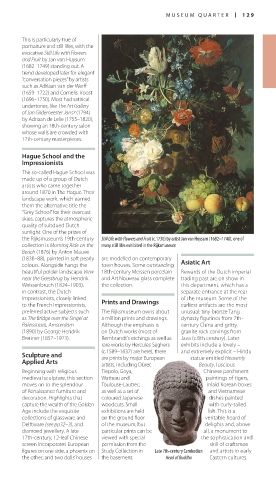
the Rijksmuseum’s 19th-century Still Life with Flowers and Fruit (c.1730) by artist Jan van Huysum (1682–1740), one of
collection is Morning Ride on the many still lifes exhibited in the Rijksmuseum
Beach (1876) by Anton Mauve
(1838–88), painted in soft pearly are modelled on contemporary Asiatic Art
colours. Alongside hangs the town houses. Some outstanding
beautiful polder landscape View 18th-century Meissen porcelain Rewards of the Dutch imperial
near the Geestbrug by Hendrik and Art Nouveau glass complete trading past are on show in
Weissenbruch (1824–1903). the collection. this department, which has a
In contrast, the Dutch separate entrance at the rear
Impressionists, closely linked Prints and Drawings of the museum. Some of the
to the French Impressionists, earliest artifacts are the most
preferred active subjects such The Rijksmuseum owns about unusual: tiny bronze Tang
as The Bridge over the Singel at a million prints and drawings. dynasty figurines from 7th-
Paleisstraat, Amsterdam Although the emphasis is century China and gritty,
(1890) by George Hendrik on Dutch works (most of granite rock carvings from
Breitner (1857–1923). Rembrandt’s etchings as well as Java (c.8th century). Later
rare works by Hercules Seghers exhibits include a lovely –
(c.1589–1637) are here), there and extremely explicit – Hindu
Sculpture and are prints by major European statue entitled Heavenly
Applied Arts
artists, including Dürer, Beauty, luscious
Beginning with religious Tiepolo, Goya, Chinese parchment
medieval sculpture, this section Watteau and paintings of tigers,
moves on to the splendour Toulouse-Lautrec, inlaid Korean boxes
of Renaissance furniture and as well as a set of and Vietnamese
decoration. Highlights that coloured Japanese dishes painted
capture the wealth of the Golden woodcuts. Small with curly-tailed
Age include the exquisite exhibitions are held fish. This is a
collections of glassware and on the ground floor veritable hoard of
Delftware (see pp32–3), and of the museum, but delights and, above
diamond jewellery. A late particular prints can be all, a monument to
17th-century, 12-leaf Chinese viewed with special the sophistication and
screen incorporates European permission from the skill of craftsmen
figures on one side, a phoenix on Study Collection in Late 7th-century Cambo dian and artists in early
the other; and two dolls’ houses the basement. Head of Buddha Eastern cultures.
128-129_EW_Netherlands.indd 129 16/01/17 12:04 pm

