


Page 134 - (DK Eyewitness) Travel Guide - The Netherlands
P. 134
132 A MSTERD A M
4 Stedelijk Museum
The Stedelijk Museum was built to house a personal
collection bequeathed to the city in 1890 by art connoisseur
Sophia de Bruyn. In 1938, the museum became the national
museum of modern art, displaying works by artists such
as Picasso, Matisse, Mondriaan, Cézanne and Monet. The
building’s new wing (nicknamed “the bath tub”) is an art piece
in itself. The museum also organizes workshops, events and
themed guided tours.
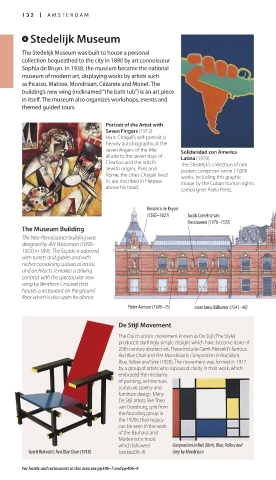
Portrait of the Artist with
Seven Fingers (1912)
Marc Chagall’s self-portrait is
heavily autobiographical; the
seven fingers of the title Solidaridad con America
allude to the seven days of Latina (1970)
Creation and the artist’s The Stedelijk’s collection of rare
Jewish origins. Paris and posters comprises some 17,000
Rome, the cities Chagall lived works, including this graphic
in, are inscribed in Hebrew image by the Cuban human rights
above his head. campaigner Asela Perez.
Hendrick de Keyser
(1565–1621) Jacob Cornelisz van
Oostzaanen (1470–1533)
The Museum Building
The Neo-Renaissance building was
designed by AW Weissman (1858–
1923) in 1895. The façade is adorned
with turrets and gables and with
niches containing statues of artists
and architects. It makes a striking
contrast with the spectacular new
wing by Benthem Crouwel that
houses a restaurant on the ground
floor which is also open for dinner.
Pieter Aertsen (1509–75) Joost Jansz Bilhamer (1541–90)
De Stijl Movement
The Dutch artistic movement known as De Stijl (The Style)
produced startlingly simple designs which have become icons of
20th-century abstract art. These include Gerrit Rietveld’s famous
Red Blue Chair and Piet Mondriaan’s Composition in Red, Black,
Blue, Yellow and Grey (1920). The movement was formed in 1917
by a group of artists who espoused clarity in their work, which
embraced the mediums
of painting, architecture,
sculpture, poetry and
furniture design. Many
De Stijl artists, like Theo
van Doesburg, split from
the founding group in
the 1920s; their legacy
can be seen in the work
of the Bauhaus and
Modernist schools
which followed Composition in Red, Black, Blue, Yellow and
Gerrit Rietveld’s Red Blue Chair (1918) (see pp208–9). Grey by Mondriaan
For hotels and restaurants in this area see pp396–7 and pp406–9
132-133_EW_Netherlands.indd 132 16/01/17 12:04 pm
Eyewitness Travel LAYERS PRINTED:
Starsight template “UK” LAYER
(Source v2.7)
Date 24th April 2013
Size 125mm x 217mm

