


Page 192 - (DK Eyewitness) Travel Guide - The Netherlands
P. 192
190 WESTERN NE THERLANDS
Frans Hals Museum
Celebrated as the first “modern” artist, Frans
Hals (c.1582–1666) introduced a new realism
into painting. Although his contemporaries
strove for perfect likenesses, Hals knew how
to capture his models’ characters by using an
impressionistic technique. Even at the age of
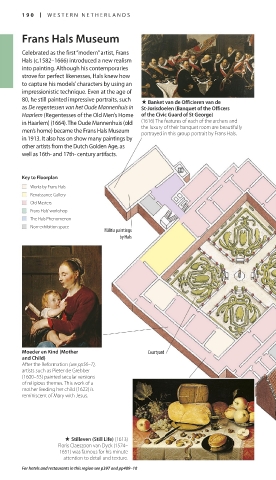
80, he still painted impressive portraits, such . Banket van de Officieren van de
as De regentessen van het Oude Mannenhuis in St-Jorisdoelen (Banquet of the Officers
Haarlem (Regentesses of the Old Men’s Home of the Civic Guard of St George)
in Haarlem) (1664). The Oude Mannenhuis (old (1616) The features of each of the archers and
the luxury of their banquet room are beautifully
men’s home) became the Frans Hals Museum portrayed in this group portrait by Frans Hals.
in 1913. It also has on show many paintings by
other artists from the Dutch Golden Age, as
well as 16th- and 17th- century artifacts.
Key to Floorplan
Works by Frans Hals
Renaissance Gallery
Old Masters
Frans Hals’ workshop
The Hals Phenomenon
Non-exhibition space
Militia paintings
by Hals
Moeder en Kind (Mother Courtyard
and Child)
After the Reformation (see pp56–7),
artists such as Pieter de Grebber
(1600–53) painted secular versions
of religious themes. This work of a
mother feeding her child (1622) is
reminiscent of Mary with Jesus.
. Stilleven (Still Life) (1613)
Floris Claeszoon van Dyck (1574–
1651) was famous for his minute
attention to detail and texture.
For hotels and restaurants in this region see p397 and pp409–10
190-191_EW_Netherlands.indd 190 16/01/17 12:04 pm
Eyewitness Travel LAYERS PRINTED:
Starsight template “UK” LAYER
(Source v2.7)
Date 24th April 2013
Size 125mm x 217mm

