


Page 25 - (DK Eyewitness) Travel Guide - The Netherlands
P. 25
A POR TR AIT OF THE NE THERLANDS 23
time, these groups had almost
no contact with one another.
Catholics would always vote for
the Katholieke Volkspartij, join
Catholic trade unions, base their
social lives on Catholic societies
and send their children to Catholic
schools. The Protestant “pillar”, on
the other hand, was formed of two
main factions: the Dutch Reformed
Church and the Calvinist Church.
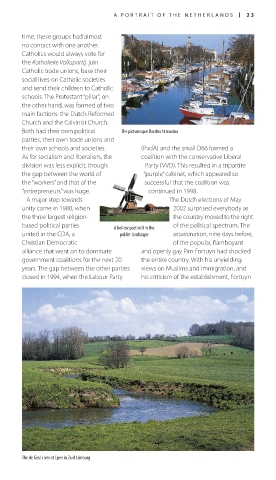
Both had their own political The picturesque Dordrecht marina
parties, their own trade unions and
their own schools and societies. (PvdA) and the small D66 formed a
As for socialism and liberalism, the coalition with the conservative Liberal
division was less explicit, though Party (VVD). This resulted in a tripartite
the gap between the world of “purple” cabinet, which appeared so
the “workers” and that of the successful that the coalition was
“entrepreneurs” was huge. continued in 1998.
A major step towards The Dutch elections of May
unity came in 1980, when 2002 surprised everybody as
the three largest religion- the country moved to the right
based political parties A hollow post mill in the of the political spectrum. The
united in the CDA, a polder landscape assassination, nine days before,
Christian Demo cratic of the popular, flamboyant
alliance that went on to dominate and openly gay Pim Fortuyn had shocked
government coalitions for the next 20 the entire country. With his unyielding
years. The gap between the other parties views on Muslims and immigration, and
closed in 1994, when the Labour Party his criticism of the establishment, Fortuyn
The de Geul river at Epen in Zuid Limburg
020-025_EW_Netherlands.indd 23 16/01/17 12:02 pm

