


Page 361 - (DK Eyewitness) Travel Guide - The Netherlands
P. 361
SOUTHERN NE THERLANDS 359
NORTH
BRABANT
The Netherland’s second-largest province is
distinguished primarily by its natural beauty. In the
south and southeast are the relatively high elevations of
Kempen and the Peel; in the northwest, the watery Biesbosch. Here, arms
of the Waal and Maas rivers converge through a wilderness of sandbanks.
North Brabant has been inhabited by and founded towns such as Breda and
humans since the earliest times. The Celts ’s-Hertogenbosch. The Duchy flourished
settled here in the 7th century BC and until the 16th century, when the 80 Years
stayed for many centuries. They were War left the south of Brabant under
defeated by Julius Caesar (see pp46–7), Spanish rule and the north under the
who describes them as the “Belgae” in his rule of the Netherlands.
writings. The Rhine became the northern Although North Brabant has its fair share
frontier of the Roman Empire and Roman of commerce and industry, and Eindhoven
remains have been found in the area. is a major manufacturing centre, tourism
When the Romans left, the Franks took has become increasingly important. The
charge of Toxandria, as the region was region’s colourful history is evident from
known in those days. Under Charlemagne the medieval buildings and bastions in
(see p48), this region grew in importance many of the towns, and the castles dotted
as new towns expanded at points along around the countryside, with a range of
trade routes, and in the 12th century fine exhibits in churches and museums.
became part of the Duchy of Brabant. The For younger visitors the highlight is the
Dukes of Brabant, among them Godfried fairytale theme park De Efteling at
III and Henry I, expanded their territory Kaatsheuvel, northeast of Breda.
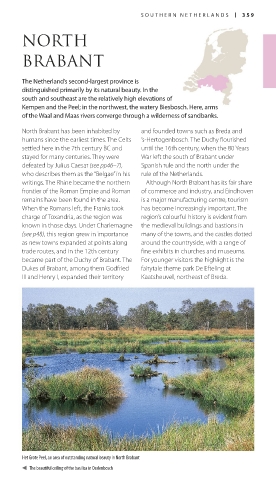
Het Grote Peel, an area of outstanding natural beauty in North Brabant
The beautiful ceiling of the basilica in Oudenbosch
358-359_EW_Netherlands.indd 359 16/01/17 12:07 pm

