


Page 373 - (DK Eyewitness) Travel Guide - The Netherlands
P. 373
SOUTHERN NE THERLANDS 371
LIMBURG
Limburg is the Netherlands’ southernmost province, squeezed
by the course of history into its present unusual shape – its
boundaries defined by Belgium to the south and to the
west and by Germany to the east. Yet its outline is not
the only remarkable thing about this delightful
multilingual province.
From a geological point of view, Limburg is Beaker Folk (see p46). The Romans were
much older than the rest of Holland, sitting here for around 400 years and Maastricht,
on coal deposits that are around 270 which they founded, has much evidence
million years old. In the mining museum of their impressive buildings. Heerlen was
at Kerkrade, east of Maastricht, you can see also an important Roman crossroads and
how coal used to be mined in this region. the bathhouse museum here makes an
The caves that can be seen in many places excellent and informative visit. In the
in South Limburg are also mines, albeit for Middle Ages, Limburg was split up and
the local limestone laid down between 60 fought over at various times by the
and 70 million years ago. The best-known German Empire, Gelder, Liège, Brabant
cave systems, parts of which date from and the Spanish. It acquired its present
the Roman era, are at Valkenburg and at borders in the 19th century. Nowadays
St Pietersberg near Maastricht. it has plenty to offer visitors, from historic
The Maas river valley has been attractive towns with fine architecture, shops and
to settlers since the last Ice Age. There is nightlife to countryside dotted with
evidence of early nomads, followed by the half-timbered houses, farms, water mills
remains of successive sedentary societies in the rivers, and countless castles and
such as the “Bandkeramikers” and the country houses.
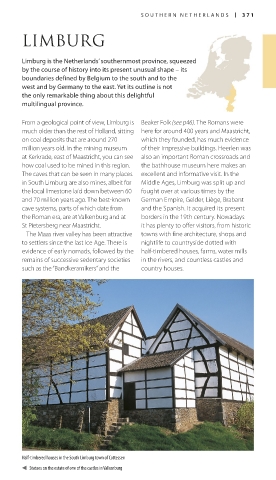
Half-timbered houses in the South Limburg town of Cottessen
Statues on the estate of one of the castles in Valkenburg
370-371_EW_Netherlands.indd 371 16/01/17 12:07 pm

