


Page 45 - (DK Eyewitness) Travel Guide - The Netherlands
P. 45
INTRODUCING THE NE THERLANDS 43
THE HISTORY OF THE
NETHERLANDS
In 12 BC, the Romans conquered southern Northern Netherlands liberated itself from
Holland, and in AD 50 they declared the the Habsburg Duke Philip II, and enjoyed a
Rhine the northern border of their empire. period of unprec edented economic and
The region north of this was conquered by cultural flowering. By the mid-17th century,
the Frisians. At the end of the 4th century, the it had become the greatest trading nation
Romans withdrew from the Low Countries, in the world, a status grad ually relinquished
which were taken over by the Frisians, Franks during the 18th century.
and Saxons. In the 8th century, the Franks The different independent regions making
ruled the region alone. Christianity was up the republic were joined together under
introduced by the missionary Willibrord in Napoleon, with William I becoming king
695, and was completed under Charlemagne. in 1815. However, unification with Belgium
After the disintegration of the Frankish proved unsuccessful and was officially
Empire, the Netherlands fell under German ended in 1839, although it had already
rule. Actual power was exercized by the ended de facto in 1830.
vassals, of whom the Bishop of Utrecht was In the 20th century, Holland maintained
the most powerful – until the Concordat neutrality during World War I, but suffered
of Worms in 1122, when the German king greatly during World War II. Invaded by the
lost the right to appoint bishops. During Nazis in May 1940, the country was not
the 12th century, the Count of Holland was liberated entirely until May 1945. It subse-
the most important figure in the region. quently developed into one of the most
In the 14th and 15th centuries, the dispute prosperous states within the European
between the two factions – the Hooks and Union. Today, the country remains a cons-
the Cods – marked the end of the feudal titutional monarchy, with the royal family
age. At the end of the 16th century, the enjoying great popularity among the Dutch.
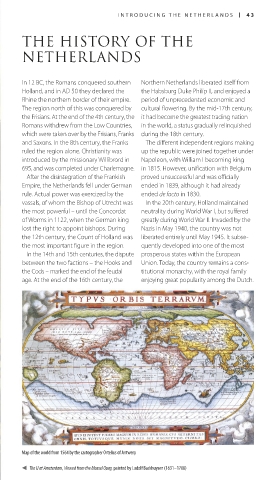
Map of the world from 1564 by the cartographer Ortelius of Antwerp
The IJ at Amsterdam, Viewed from the Mussel Quay, painted by Ludolf Backhuysen (1631–1708)
042-043_EW_Netherlands.indd 43 16/01/17 11:53 am

