


Page 49 - (DK Eyewitness) Travel Guide - The Netherlands
P. 49
THE HIST OR Y OF THE NE THERLANDS 47
Where to See
Prehistoric and
Roman Holland
In addition to the megaliths
of Drenthe and the Someren
urnfield, prehistoric graves
have been discovered at
Almere, Hilversum, Vaassen,
Lunteren, Goirle and Rolde,
and at Toterfout/Halfmijl
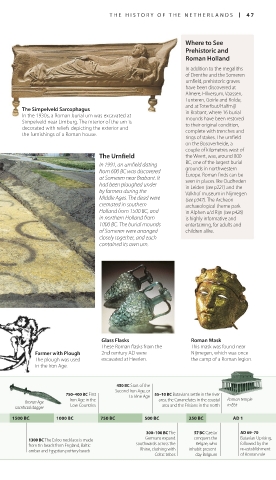
The Simpelveld Sarcophagus in Brabant, where 16 burial
In the 1930s, a Roman burial urn was excavated at mounds have been restored
Simpelveld near Limburg. The interior of the urn is to their original condition,
decorated with reliefs depicting the exterior and complete with trenches and
the furnishings of a Roman house.
rings of stakes. The urnfield
on the Bosoverheide, a
couple of kilometres west of
The Urnfield the Weert, was, around 800
In 1991, an urnfield dating BC, one of the largest burial
from 600 BC was discovered grounds in northwestern
Europe. Roman finds can be
at Someren near Brabant. It seen in places like Oudheden
had been ploughed under in Leiden (see p221) and the
by farmers during the Valkhof museum in Nijmegen
Middle Ages. The dead were (see p347). The Archeon
cremated in southern archaeological theme park
Holland from 1500 BC, and in Alphen a/d Rijn (see p426)
in northern Holland from is highly informative and
1000 BC. The burial mounds entertaining, for adults and
of Someren were arranged children alike.
closely together, and each
contained its own urn.
Glass Flasks Roman Mask
These Roman flasks from the This mask was found near
Farmer with Plough 2nd century AD were Nijmegen, which was once
The plough was used excavated at Heerlen. the camp of a Roman legion.
in the Iron Age.
450 BC Start of the
1900 BC Start of 750–400 BC First Second Iron Age, or 55–10 BC Batavians settle in the river
the Bronze Age in Iron Age in the La Tène Age area, the Cananefates in the coastal Roman temple
the Low Countries Bronze Age Low Countries area and the Frisians in the north in Elst
sacrificial dagger
1500 BC 1000 BC 750 BC 500 BC 250 BC AD 1
300–100 BC The 57 BC Caesar AD 69–70
1300 BC The Exloo necklace is made Germans expand conquers the Batavian Uprising,
from tin beads from England, Baltic southwards across the Belgae, who followed by the
amber and Egyptian pottery beads Rhine, clashing with inhabit present- re-establishment
Celtic tribes day Belgium of Roman rule
046-047_EW_Netherlands.indd 47 16/01/17 12:02 pm

