


Page 46 - (DK Eyewitness) Travel Guide - The Netherlands
P. 46
44 INTRODUCING THE NE THERLANDS
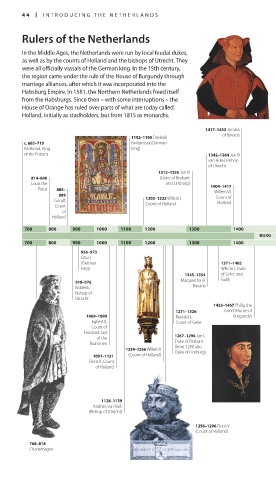
Rulers of the Netherlands
In the Middle Ages, the Netherlands were run by local feudal dukes,
as well as by the counts of Holland and the bishops of Utrecht. They
were all officially vassals of the German king. In the 15th century,
the region came under the rule of the House of Burgundy through
marriage alliances, after which it was incorporated into the
Habsburg Empire. In 1581, the Northern Netherlands freed itself
from the Habsburgs. Since then – with some interruptions – the 1559–1567 and 1572–1584
William of Orange, “The Silent”
House of Orange has ruled over parts of what are today called (stadholder of Holland, Zeeland
Holland, initially as stadholders, but from 1815 as monarchs. and Utrecht, under Philip II
until 1581)
1417–1433 Jacoba
of Bavaria
1152–1190 Frederik
c. 685–719 Barbarossa (German
Radboud, King king)
of the Frisians 1342–1364 Jan IV
van Arkel, Bishop
of Utrecht
1312–1355 Jan III
814–840 (Duke of Brabant
Louis the and Limburg)
Pious 885– 1404–1417
Willem VI,
889 Count of
Gerulf, 1203–1222 Willem I, Holland
Count Count of Holland
of
Holland
700 800 900 1000 1100 1200 1300 1400
BURG UNDY
700 800 900 1000 1100 1200 1300 1400
936–973
Otto I
(German 1371–1402
king) Willem I, Duke
1345–1354 of Gelre and
918–976 Margaretha of Gulik
Balderik, Bavaria
Bishop of
Utrecht
1433–1467 Philip the
1271–1326 Good (House of
1069–1090 Reinald I, Burgundy)
Egbert II, Count of Gelre
Count of
Friesland, last
of the 1267–1294 Jan I,
Brunonen Duke of Brabant
(from 1288 also
1234–1256 Willem II Duke of Limburg)
1091–1121 (Count of Holland)
Floris II, Count
of Holland
1128–1139
Andries van Kuik
(Bishop of Utrecht)
1256–1296 Floris V
(Count of Holland)
768–814
Charlemagne
044-045_EW_Netherlands.indd 44 16/01/17 11:53 am

