


Page 222 - (DK Eyewitness) Back Roads Travel Guide - France
P. 222
220 BACK ROADS FRANCE
9 Gorges du Tarn
Lozère, Languedoc-Roussillon; 48210
Often referred to as the Grand Canyon
of Europe, the Gorges du Tarn is a
great fissure slashed through the lime-
stone plateaux by the Tarn river. There
are amazing views as the road snakes
along the side of the gorge from
Ispagnac to Peyreleau, domina ted by
craggy cliffs of rock. Below are stun-
ning views of the emerald waters. It
is a superb location for walk ing,
canoeing and bird-watching. Along
the way are the cascades of tributary
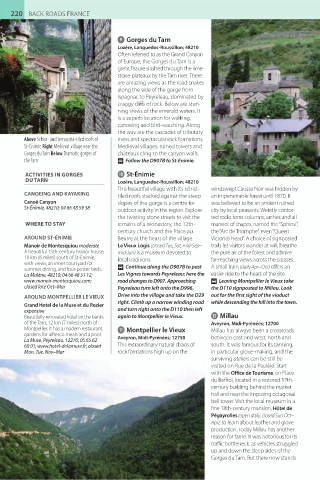
Above Schist- and terracotta-tiled roofs of rivers and spectacular rock formations.
St-Énimie Right Medieval village near the Medieval villages, ruined towers and
Gorges du Tarn Below Dramatic gorges of châteaux cling to the canyon walls.
the Tarn ª Follow the D907B to St-Enimie.
ACTIVITIES IN GORGES 0 St-Énimie
DU TARN Lozère, Languedoc-Roussillon; 48210
This beautiful village with its schist- windswept Causse Noir was hidden by
CANOEING AND KAYAKING tiled roofs stacked against the steep an impenetrable forest until 1870. It
Canoë Canyon slopes of the gorge is a centre for was believed to be an ancient ruined
St-Énimie, 48210; 04 66 48 59 38
outdoor activity in the region. Explore city by local peasants. Weirdly contor-
the twisting stone streets to visit the ted rocks form columns, arches and all
WHERE TO STAY remains of a monastery, the 12th- manner of shapes, named the “Sphinx”,
century church and the Place au the “Arc de Triomphe”, even “Queen
AROUND STÉNIMIE Beurre at the heart of the village. Victoria’s head”. A choice of sign posted
Manoir de Montesquiou moderate Le Vieux Logis (closed Tue, Sat, mid-Sep– trails let visitors wander at will, breathe
A beautiful 15th-century manor house, mid-Jun) is a museum devoted to the pure air of the forest and admire
10 km (6 miles) south of St-Enimie, local traditions. far-reaching views across the causses.
with views, an inner courtyard for
summer dining, and four-poster beds. ª Continue along the D907B to past A small train (daily Apr–Oct) offers an
La Malène, 48210; 04 66 48 51 12; Les Vignes towards Peyreleau; here the easier ride to the heart of the site.
www.manoir-montesquiou.com; road changes to D907. Approaching ª Leaving Montpellier le Vieux take
closed late Oct–Mar Peyreleau turn left onto the D996. the D110 signposted to Millau. Look
Drive into the village and take the D29 out for the first sight of the viaduct
AROUND MONTPELLIER LE VIEUX
right. Climb up a narrow winding road while descending the hill into the town.
Grand Hotel de la Muse et du Rozier
expensive and turn right onto the D110 then left
Beautifully renovated hotel on the banks again to Montpellier le Vieux. w Millau
of the Tarn, 12 km (7 miles) north of Aveyron, Midi-Pyrénées; 12700
Montpellier. It has a modern restaurant, q Montpellier le Vieux Millau has always been a crossroads
gardens for alfresco meals and a pool.
La Muse, Peyreleau, 12270; 05 65 62 Aveyron, Midi-Pyrénées; 12750 between east and west, north and
60 01; www.hotel-delamuse.fr; closed This extraordinary natural chaos of south. It was famous for its tanning,
Mon, Tue, Nov–Mar rock formations high up on the in particular glove-making, and the
surviving ateliers can be still be
visited on Rue de la Paulèle. Start
with the Office de Tourisme, on Place
du Beffroi, located in a restored 17th-
century building behind the market
hall and near the imposing octagonal
bell tower. Visit the local museum in a
fine 18th-century mansion, Hôtel de
Pégayrolles (open daily, closed Sun Oct–
Apr), to learn about leather and glove
production. Today Millau has another
reason for fame. It was notorious for its
traffic bottle neck, as vehicles struggled
up and down the steep sides of the
Gorges du Tarn. But there now stands

