


Page 100 - (DK Eyewitness) Travel Guide - Milan & The Lakes
P. 100
98 MILAN AREA B Y AREA
2 Torre Velasca Apostles Andrew, John
and Thomas, which is why
Piazza Velasca 5. Map 7 C2. q 3 it was known as the Basilica
Missori. v 12, 15, 16, 24, 27. @ 94. Apostolorum. It was dedicated
to San Nazaro when his remains
This tower, built in the late – found by Sant’Ambrogio near
1950s by architects Belgioioso, the basi lica – were buried here
Nathan Rogers and Peressutti, in 396. The church was built
is one of the best-known outside the walls in an Early
monuments in modern-day Christian burial ground – as
Milan. The over-hang of the can be seen by the sarcophagi
upper part of the building and outside and the epitaph in
its red colour are reminiscent the right-hand transept – and
of Italian medieval towers, but looked onto an ancient Roman
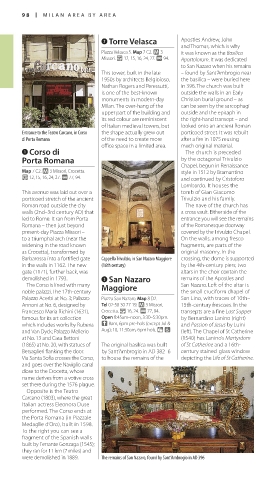
Entrance to the Teatro Carcano, in Corso the shape actually grew out porticoed street. It was rebuilt
di Porta Romana of the need to create more after a fire in 1075 reusing
office space in a limited area. much original material.
1 Corso di The church is preceded
Porta Romana by the octagonal Trivulzio
Chapel, begun in Renaissance
Map 7 C2. q 3 Missori, Crocetta. style in 1512 by Bramantino
v 12, 15, 16, 24, 27. @ 77, 94. and continued by Cristoforo
Lombardo. It houses the
This avenue was laid out over a tomb of Gian Giacomo
porticoed stretch of the ancient Trivulzio and his family.
Roman road out side the city The nave of the church has
walls (2nd–3rd century AD) that a cross vault. Either side of the
led to Rome. It ran from Porta entrance you will see the remains
Romana – then just beyond of the Romanesque doorway
present-day Piazza Missori – covered by the Tri vulzio Chapel.
to a trium phal arch (near the On the walls, among fresco
widening in the road known fragments, are parts of the
as Crocet ta), transformed by original masonry. In the
Barba rossa into a fortified gate Cappella Trivulzio, in San Nazaro Maggiore crossing, the dome is supported
in the walls in 1162. The new (16th century) by the 4th-century piers; two
gate (1171), further back, was altars in the choir contain the
demolished in 1793. 3 San Nazaro remains of the Apostles and
The Corso is lined with many Maggiore San Nazaro. Left of the altar is
noble palazzi. The 17th-century the small cruci form chapel of
Palazzo Acerbi at No. 3; Palazzo Piazza San Nazaro. Map 8 D2. San Lino, with traces of 10th–
Annoni at No. 6, designed by Tel 02-58 30 77 19. q 3 Missori, 15th-century frescoes. In the
Francesco Maria Richini (1631), Crocetta. v 16, 24. @ 77, 94. transepts are a fine Last Supper
famous for its art collection Open 8:45am–noon, 3:30–5:30pm. by Bernar dino Lanino (right)
which includes works by Rubens 5 8am, 6pm pre-hols (except Jul & and Passion of Jesus by Luini
and Van Dyck; Palazzo Mel lerio Aug); 10, 11:30am, 6pm hols. = 7 (left). The Chapel of St Catherine
at No. 13 and Casa Bet toni (1540) has Lanino’s Martyr dom
(1865) at No. 20, with statues of The original basilica was built of St Catherine and a 16th-
Bersaglieri flanking the door. by Sant’Ambrogio in AD 382–6 century stained-glass window
Via Santa Sofia crosses the Corso, to house the remains of the depicting the Life of St Catherine.
and goes over the Naviglio canal
close to the Crocetta, whose
name derives from a votive cross
set there during the 1576 plague.
Opposite is the Teatro
Car cano (1803), where the great
Italian actress Eleonora Duse
performed. The Corso ends at
the Porta Romana (in Piazzale
Medaglie d’Oro), built in 1598.
To the right you can see a
fragment of the Spanish walls
built by Ferrante Gonzaga (1545);
they ran for 11 km (7 miles) and
were demolished in 1889. The remains of San Nazaro, found by Sant’Ambrogio in AD 396
098-099_EW_Milan.indd 98 20/10/16 3:19 pm
Eyewitness Travel LAYERS PRINTED:
Catalogue template “UK” LAYER
(Source v2.7)
Date 1st October 2013
Size 125mm x 217mm

