


Page 120 - (DK Eyewitness) Travel Guide - Milan & The Lakes
P. 120
118 MILAN AREA B Y AREA
Exploring the Pinacoteca di Brera (1453–4). Giovanni Bellini
is represented by two
The original nucleus of the Brera Gallery consisted mainly Madonnas with Child and
of plaster casts and drawings used as models for the art Carpaccio by Legend of the
students of the Accademia di Belle Arti (founded in 1776). Virgin. There are portraits
This collection was augmented with works from suppressed by Lorenzo Lotto in room 7,
alongside Mantegna’s master
churches in Northern Italy and was officially opened in 1809, piece Dead Christ and Bellini’s
the paintings being arranged in rows on the wall, from floor Pietà (c.1470). St Mark Preaching
to ceiling. The Pinacoteca became independent from the in Alexandria (room 8) was
Accademia in 1882, and its fine collection further expanded painted for the Scuola Grande
through 19th- and 20th-century donations. The gallery has in St Mark’s in Venice by
Giovanni and Gentile Bellini.
always suffered from lack of space, but there are plans to The following room has
use the adjacent Palazzo Citterio. works by Titian and Paolo
Veronese, as well as the
Finding of the Body of St Mark,
which Tintoretto painted for
Tommaso Rangone, who is
portrayed as the kneeling man
in the middle of the scene.
15th–16th-Century
Lombard Painting
A large collection of 15th–
16thcentury Lombard
paintings is exhibited in rooms
15, 18 and 19. The leading
The City Rises (c.1910) by Umberto Boccioni figure, Vincenzo Foppa, is
represented by the Polittico
Vene ziano (14th century), delle Grazie (c.1483). An
Jesi Collection Ambro gio Lorenzetti’s unknown master contributed
The 72 works donated by Madonna and Child and Christ the Sforzesca Altarpiece (1494),
Emilio and Maria Jesi in 1976 the Judge by Giovanni da showing Lodovico il Moro
and 1984 are on show in room Milano. A fine example of the and his family worshipping
10. The collection, mostly by International Gothic style is the Madonna. This room also
Italian artists, covers the 1910– the Valle Romita Polyptycb by has works by Bergognone,
40 period. Key works include Gentile da Fabriano, flanked by Gaudenzio Ferrari – an artist
Portrait of Moisè Kisling (see Stefano da Verona’s Adoration with a marked narrative
p116) by Modigliani, Umberto of the Magi (1435), in which vein, as can be seen in
Boccioni’s Brawl in the Galleria the viola and carnation at Martyrdom of St Catherine –
(1911) and The City Rises (a the feet of Jesus symbolize and Bramantino’s Crucifixion.
study for the canvas now in his humility and the Passion. Works influenced by Leonardo
the New York MOMA), Carlo da Vinci include the
Carrà’s The Metaphysical Muse 15th–16th- small paintings
(1917) and still lifes by Giorgio
Morandi, as well as sculpture Century
Venetian
by Medardo Rosso, Arturo
Martini and Marino Marini. Painting
Rooms 5 and 6
feature works
13th–15th-Century by 15th–16th
Italian Painting
century artists
The section given over to active in the
13th–15thcentury Italian Veneto such
art (rooms 2–4) includes as Giovanni
frescoes from the Oratory d’Alemagna and
at Mocchirolo, painted by Antonio Vivarini,
an unknown Lombard master who painted the
in around 1365–70. Among Praglia Polyptych
the goldbackground works (1448). Room
are the Santa Maria della 6 has Mantegna’s
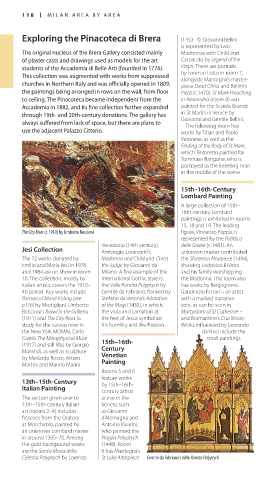
Celestia Polyptych by Lorenzo St Luke Altarpiece Gentile da Fabriano’s Valle Romita Polyptych
118-119_EW_Milan.indd 118 20/10/16 3:19 pm
Eyewitness Travel LAYERS PRINTED:
Catalogue template “UK” LAYER
(Source v2.7)
Date 1st October 2013
Size 125mm x 217mm

