


Page 121 - (DK Eyewitness) Travel Guide - Milan & The Lakes
P. 121
NOR THEAST MILAN 119
18th–19th-Century
Italian Painting
The following rooms cover
various genres in 18th-century
Italian art. Large-scale religious
paintings are displayed in room
34 with works by the Neapolitan
Luca Giordano and Giovan
Battista Tiepolo’s Madonna del
Carmelo (1721–7), intended
to be viewed from the side.
Another Venetian artist,
Piazzetta, has his Rebecca at
the Well displayed in room 35.
Giacomo Ceruti (Il Pitochetto)
represents “genre painting”,
which was popular in the
18th century. This is followed
by Venetian vedutismo views
by Bernardo Bellotto, Guardi
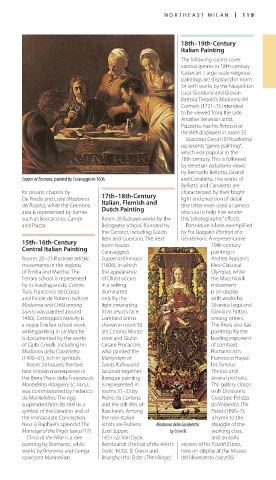
Supper at Emmaus, painted by Caravaggio in 1606 and Canaletto. The works of
Bellotto and Canaletto are
for private chapels by 17th–18th-Century characterized by their bright
De Predis and Luini (Madonna light and precision of detail
del Roseto), while the Cremona Italian, Flemish and (the latter even used a camera
Dutch Painting
area is represented by names obscura to help him render
such as Boc caccino, Campi Room 28 features works by the this “photographic” effect).
and Piazza. Bolognese school, founded by Portraiture is best exem plified
the Carracci, including Guido by Fra Galgario (Portrait of a
Reni and Guercino. The next Gentleman). A representative
15th–16th-Century room boasts 19th-century
Central Italian Painting Caravaggio’s painting is
Rooms 20–23 illustrate artistic Supper at Emmaus Andrea Appiani’s
movements in the regions (1606), in which Neo-Classical
of Emilia and Marche. The the appearance Olympus, while
Ferrara school is represented of Christ occurs the Macchiaioli
by its leading artists, Cosmè in a setting movement
Tura, Francesco del Cossa illuminated is on display
and Ercole de’ Roberti (whose only by the with works by
Madonna and Child among light emanating Sil vestro Lega and
Saints was painted around from Jesus’s face. Giovanni Fattori,
1480). Correggio’s Nativity is Lombard artists among others.
a major Emilian school work, shown in room 30 The Brera also has
while painting in Le Marche are Cerano, Moraz- paintings by the
is documented by the works zone and Giulio leading exponent
of Carlo Crivelli, including his Cesare Procaccini, of Lombard
Madonna della Candeletta who painted the Romanticism,
(1490–91), rich in symbols. Martyrdom of Francesco Hayez:
Room 24 houses the two Saints Rufina and his famous
best-known masterpieces in Secunda together. The Kiss and
the Brera. Piero della Fran cesca’s Baroque painting several portraits.
Montefeltro Altarpiece (c.1475), is represented in The gallery closes
was commissioned by Federico rooms 31–33 by with Divisionist
da Montefeltro. The egg Pietro da Cortona Giuseppe Pelizza
suspended from its shell is a and the still lifes of da Volpedo’s The
symbol of the Creation and of Baschenis. Among Flood (1895–7),
the Immacu late Conception. the non-Italian a hymn to the
Next is Raphael’s splendid The artists are Rubens Madonna della Candeletta struggle of the
Marriage of the Virgin (see p117). (Last Supper, by Crivelli working class,
Christ at the Pillar is a rare 1631–2), Van Dyck, and an early
painting by Bramante, while Rembrandt (Portrait of the Artist’s version of his Fourth Estate,
works by Bronzino and Genga Sister, 1632), El Greco and now on display at the Museo
represent Mannerism. Brueghel the Elder (The Village). del Novecento (see p56).
118-119_EW_Milan.indd 119 20/10/16 3:19 pm

