


Page 126 - (DK Eyewitness) Travel Guide - Milan & The Lakes
P. 126
124 MILAN AREA B Y AREA
d Corso Venezia
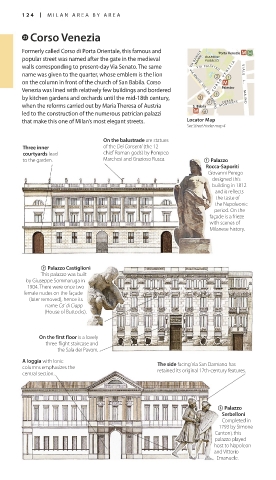
Formerly called Corso di Porta Orientale, this famous and Porta Venezia
MANIN
popular street was named after the gate in the medieval VIA DANIELE GIARDINI
PUBBLICI
walls corresponding to present-day Via Senato. The same V I A P A L ES T R O
name was given to the quarter, whose emblem is the lion C O R S O V E N E Z I A
2
1
on the column in front of the church of San Babila. Corso V I A L E L . M A J N O
Venezia was lined with relatively few buildings and bordered VIA SENATO VIA SAN DAMIA NO Palestro
by kitchen gardens and orchards until the mid-18th century, 5 3 C O R S O
when the reforms carried out by Maria Theresa of Austria S. Babila 4 M O N F O R T E
led to the construction of the numerous patrician palazzi 6
that make this one of Milan’s most elegant streets. Locator Map
See Street Finder map 4
On the balustrade are statues
Three inner of the Dei Consenti (the 12
courtyards lead chief Roman gods) by Pompeo
to the garden. Marchesi and Grazioso Rusca. 1 Palazzo
Rocca-Saporiti
Giovanni Perego
designed this
building in 1812
and it reflects
the taste of
the Napoleonic
period. On the
façade is a frieze
with scenes of
Milanese history.
2 Palazzo Castiglioni
This palazzo was built
by Giuseppe Sommaruga in
1904. There were once two
female nudes on the façade
(later removed), hence its
name Ca’ di Ciapp
(House of Buttocks).
On the first floor is a lovely
three-flight staircase and
the Sala dei Pavoni.
A loggia with Ionic The side facing Via San Damiano has
columns emphasizes the retained its original 17th-century features.
central section.
3 Palazzo
Serbelloni
Completed in
1793 by Simone
Cantoni, this
palazzo played
host to Napoleon
and Vittorio
Emanuele.
124-125_EW_Milan.indd 124 20/10/16 3:19 pm
Eyewitness Travel LAYERS PRINTED:
Starsight template “UK” LAYER
(Source v2.7)
Date 24th April 2013
Size 125mm x 217mm

