


Page 52 - (DK Eyewitness) Travel Guide - Milan & The Lakes
P. 52
50 MILAN AREA B Y AREA
Exploring the Duomo
So that the Duomo could be built, a great Jubilee was
proclaimed in 1390 in order to urge the Milanese to
contribute money and manual labour to carry out the work.
The initial plan was to build it in fired bricks, as the excava
tions in the northern sacristy have revealed, but in 1387
Duke Gian Gale azzo Visconti, who wanted the cathedral
to be seen as a great symbol of his power, demanded that
marble should be used instead and that the archi tectural
style should be International Gothic. Building continued
over five centuries, resulting in the obvious mixture of styles
that characterizes the cathedral.
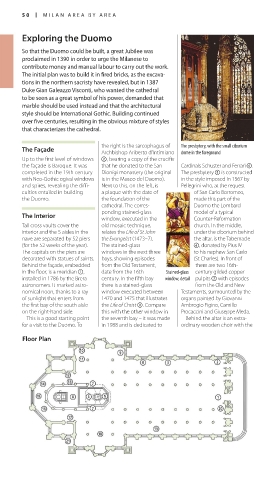
the right is the sarco phagus of The presbytery, with the small ciborium
The Façade
Archbishop Ariberto d’Intimiano dome in the foreground
Up to the first level of windows 2, bearing a copy of the crucifix
the façade is Baroque. It was that he donated to the San Cardinals Schuster and Ferrari 4.
completed in the 19th century Dionigi monastery (the original The presbytery 5 is constructed
with Neo-Gothic ogival windows is in the Museo del Duomo). in the style imposed in 1567 by
and spires, revealing the diffi- Next to this, on the left, is Pellegrini who, at the request
culties entailed in building a plaque with the date of of San Carlo Borromeo,
the Duomo. the foundation of the made this part of the
cathedral. The corres- Duomo the Lombard
ponding stained-glass model of a typical
The Interior
window, executed in the Counter-Reformation
Tall cross vaults cover the old mosaic technique, church. In the middle,
interior and the 5 aisles in the relates the Life of St John under the ciborium behind
nave are separated by 52 piers the Evangelist (1473–7). the altar, is the Tabernacle
(for the 52 weeks of the year). The stained-glass 6, donated by Pius IV
The capitals on the piers are windows in the next three to his nephew San Carlo
decorated with statues of saints. bays, showing episodes (St Charles). In front of
Behind the façade, embedded from the Old Testament, them are two 16th-
in the floor, is a meridian 1, date from the 16th Stained-glass century gilded copper
in stalled in 1786 by the Brera century. In the fifth bay window, detail pulpits 7 with episodes
astronomers. It marked astro- there is a stained-glass from the Old and New
nomical noon, thanks to a ray window executed between Testaments, surmounted by the
of sunlight that enters from 1470 and 1475 that illustrates organs painted by Giovanni
the first bay of the south aisle the Life of Christ 3. Compare Ambrogio Figino, Camillo
on the right-hand side. this with the other window in Procaccini and Giuseppe Meda.
This is a good starting point the seventh bay – it was made Behind the altar is an extra-
for a visit to the Duomo. To in 1988 and is dedicated to ordinary wooden choir with the
Floor Plan
050-051_EW_Milan.indd 50 20/10/16 3:19 pm
Eyewitness Travel LAYERS PRINTED:
Catalogue template “UK” LAYER
(Source v2.7)
Date 1st October 2013
Size 125mm x 217mm

