


Page 53 - (DK Eyewitness) Travel Guide - Milan & The Lakes
P. 53
HIST ORIC CENTRE 51
where, according to tradition,
The Holy Nail of the Cross Sant’Ambrogio (St Ambrose)
In the vault above the choir, a red light marks baptized St Augustine in AD
the location of the niche where a nail from 387. From San Carlo’s feast day
Christ’s Cross has been kept since 1461. to Epiphany, the Quadroni di
The nail, which was once kept in the early San Carlo go on display in
medieval Santa Maria Maggiore, is in the the nave. These paintings, the
shape of a horse shoe and was found by St work of leading 17th-century
Helena and later given to her son, Emperor Lombard artists, depict the
Tabernacle of the Nail Con stantine. It was later donated to story of the life and miracles
of the Cross Sant’Ambrogio and carried by San Carlo of San Carlo.
in procession during the 1576 plague.
It is shown to the public every 14 September, when the Bishop
of Milan is raised up to the level of the niche which holds the Roof Terraces
nail in a kind of decorated balcony, drawn by invisible pulleys. On the way to the lift a which
goes up to the roof, you should
go to the apse to admire the
Life of Sant’Ambrogio 8, carved ends at the northern portal central stained-glass window,
in 1572–1620. In the right- of the sacristy u, with Christ the designed by Filippino degli
hand transept is the funerary Lord and Judge (1389). The left- Organi in 1402. From the roof
monument of Gian Giacomo hand transept is dominated by there is a magnificent view of
Medici 9, the brother of the 5-m (16-ft) bronze Trivulzio the city and the mountains
Pope Pius IV, which was once Candelabrum i, a 12th- to the north, as well as the
attributed to Michelangelo century masterpiece by the Duomo spires and statues and
but is in fact the work of goldsmith Nicola da Verdun. even the buttresses below.
Leone Leoni (1560–63). The candelabrum carries
Past the chapel dedi- scenes from the Old
cated to St John the Testament and the Three Museo del Duomo
Good, Bishop of Milan Wise Men riding towards The Cathedral museum,
in the 7th century, above the enthroned Virgin. founded in 1953, is at No. 15
the side entrance is the Going down the north aisle, Via Arcivescovado. It houses
splendid stained-glass you will see the Chapel of paintings, sculptures, religious
window of St Catherine the Crucifix o carried by objects and stained-glass
of Alexandria 0, designed San Carlo in procession windows from the Duomo.
by the Arcimboldi during the 1576 plague. Among the best works are
brothers in 1556. A little Behind this is a window St Paul the Hermit, Tintoretto’s
further on is the strange with a depiction of the Christ among the Doctors (1530)
statue of the flayed Chalice in the Discovery of the True and a wooden model of the
St Bartholomew q, Duomo Treasury Cross by St Helena Duomo, begun in 1519. It
signed and dated 1562 (1570–77). To the focuses on both the hist orical
by Marco d’Agrate. left of the entrance, steps lead and artistic elements of the
At the beginning of the down to the remains of an Early Duomo, and also docu ments
ambulatory there is a Deposition Christian apse of Santa Tecla the restoration of the four
on the southern door of the and an octagonal baptistery p central piers (1981–4).
sacristy w (1393), dedicated
to the “Mysteries of the Virgin
Mary”. Steps e lead to the
crypt (1606), where San Carlo
Borromeo is buried, the Duomo
Treasury, with its exceptional
collection of church vestments
and objects, and the Coro
Jemale, a small 16th-century
room decorated with fine
stucco work (check out the relief
sculpture cycle of the Life of
the Virgin Mary, a 17th-century
masterpiece). The apse is
illuminated by the three huge
19th-century stained-glass
windows by the Bertini brothers
with episodes from the Old y
and New r Testaments and the
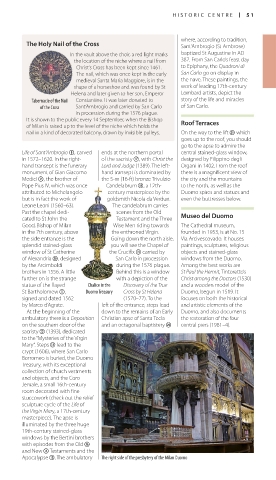
Apoca lypse t. The ambulatory The right side of the presbytery of the Milan Duomo
050-051_EW_Milan.indd 51 20/10/16 3:19 pm

