


Page 78 - (DK Eyewitness) Travel Guide - Milan & The Lakes
P. 78
76 MILAN AREA B Y AREA
e Corso Magenta
Map 3 A5. q 1 Conciliazione, 1, 2
Cadorna. v 16, 27. @ 18.
This street is fascinating, with
its elegant shops and historic
buildings making it one of
the loveliest and most elegant
quarters in Milan. At No. 65, just
past Santa Maria delle Grazie,
is a building incor porating the
remains of the Atellani residence,
decorated by Luini, where
Leonardo da
Vinci stayed
while working
on The Last
Supper. Piero
Portaluppi
carried out
the work on
No. 65 in
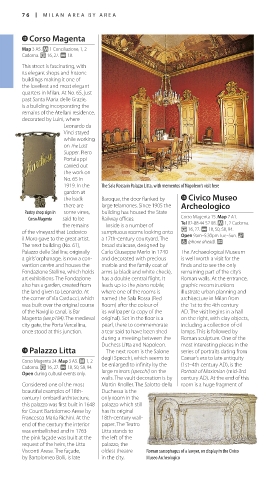
1919. In the The Sala Rossa in Palazzo Litta, with mementos of Napoleon’s visit here
garden at
the back Baroque, the door flanked by t Civico Museo
there are large telamones. Since 1905 the Archeologico
Pastry shop sign in some vines, building has housed the State
Corso Magenta said to be Railway offices. Corso Magenta 15. Map 7 A1.
the remains Inside is a number of Tel 0288 44 52 08. q 1, 2 Cadorna.
v 16, 27. @ 18, 50, 58, 94.
of the vineyard that Lodovico sumptuous rooms looking onto Open 9am–5:30pm Tue–Sun. &
il Moro gave to the great artist. a 17thcentury courtyard. The 7 (phone ahead). ^
The next building (No. 61), broad staircase, designed by
Palazzo delle Stelline, originally Carlo Giuseppe Merlo in 1740 The Archaeological Museum
a girls’ orphanage, is now a con and decorated with precious is well worth a visit for the
ven tion centre and houses the marble and the family coat of finds and to see the only
Fondazione Stelline, which holds arms (a black and white check), remaining part of the city’s
art exhibitions. The Fondazione has a double central flight. It Roman walls. At the entrance,
also has a garden, created from leads up to the piano nobile, graphic reconstructions
the land given to Leonardo. At where one of the rooms is illustrate urban planning and
the corner of Via Carducci, which named the Sala Rossa (Red architecture in Milan from
was built over the original course Room) after the colour of the 1st to the 4th century
of the Naviglio canal, is Bar its wall paper (a copy of the AD. The visit begins in a hall
Magenta (see p184). The medieval original). Set in the floor is a on the right, with clay objects,
city gate, the Porta Vercellina, pearl, there to commemorate including a collection of oil
once stood at this junction. a tear said to have been shed lamps. This is followed by
during a meeting between the Roman sculpture. One of the
Duchess Litta and Napoleon. most interesting pieces in the
r Palazzo Litta The next room is the Salone series of portraits dating from
degli Specchi, which seems to Caesar’s era to late antiquity
Corso Magenta 24. Map 3 A5. q 1, 2
Cadorna. v 16, 27. @ 18, 50, 58, 94. be enlarged to infinity by the (1st–4th century AD), is the
Open during cultural events only. large mirrors (specchi) on the Portrait of Maxi mian (mid3rd
walls. The vault decoration is by century AD). At the end of this
Considered one of the most Martin Knoller. The Salotto della room is a huge fragment of
beautiful examples of 18th Duchessa is the
century Lombard architecture, only room in the
this palazzo was first built in 1648 palazzo which still
for Count Barto lomeo Arese by has its original
Francesco Maria Richini. At the 18thcentury wall
end of the century the interior paper. The Teatro
was embellished and in 1763 Litta stands to
the pink façade was built at the the left of the
request of the heirs, the Litta palazzo, the
Visconti Arese. The façade, oldest theatre Roman sarcophagus of a lawyer, on display in the Civico
by Bartolomeo Bolli, is late in the city. Museo Archeologico
076-077_EW_Milan.indd 76 20/10/16 3:19 pm
Eyewitness Travel LAYERS PRINTED:
Catalogue template “UK” LAYER
(Source v2.7)
Date 1st October 2013
Size 125mm x 217mm

