


Page 79 - (DK Eyewitness) Travel Guide - Milan & The Lakes
P. 79
NOR THWEST MILAN 77
a torso of Hercules from the y San Maurizio
Milanese thermae, dating from Corso Magenta 13.
the first half of the 2nd century Map 7 A1. Tel 02-86 66 60
AD. Behind this are some (Santa Maria alla Porta).
3rd-century AD floor mosaics q 1, 2 Cadorna. v 16, 27.
found in Milanese houses. @ 50, 58, 94. Open 9:30am–
By the window are two of 5:30pm Tue–Sat. 5 6pm
the most important works in Mon–Fri, 10:15am (Greek–
the museum: the Parabiago Albanian) Sun.
Patera and the Diatreta Cup.
The Patera is a gilded silver In 1503 Gian Giacomo
plate with a relief of the Dolcebuono began The Roman ruins in Via Brisa
triumph of the goddess Cybele, construction of this
mother of the gods, on a church, which was intended u Via Brisa
chariot pulled by lions for the most powerful Map 7 B1. q 1, 2 Cadorna. v 16, 27.
and surrounded by closed order of @ 50, 58.
the Sun and Moon Benedictine nuns in
and sea and Zodiac Milan, with one hall Excavations carried out after
divinities (mid-4th for the public and the 1943 bombing of this
century AD). The another for the nuns. street revealed Roman ruins
marvellous Diatreta In the first hall, to which were probably part of
Cup, also dating the right of the Maximian’s imperial palace:
from the 4th century altar, is the opening the foundation of a round hall
AD, comes from through which the surrounded by apsidal halls
Novara and consists Stela with portraits, nuns receive the and preceded by a narthex.
of a single piece of Museo Archeologico Body of Christ. Most Note the columns that raised
coloured glass, with of the decoration the pavement to allow warm
finely wrought, intricate was done by Bernardino Luini. air to pass into the palace.
decoration. Winding around He painted the frescoes in the
the cup is the inscription Bibe first hall, including the Life of
vivas multis annis (“Drink and St Catherine (third chapel to the i Piazza Cordusio
you will live many years”). right) and those on the middle Map 7 C1. q 1 Cordusio. v 1, 2, 3,
The entrance hall leads to wall. The second chapel on the 12, 14, 16, 27.
a courtyard, where you will right was decorated by Callisto
see the Torre di Ansperto, a Piazza, the chapels to the left This oval-shaped piazza
Roman tower, from the ancient by pupils of Luini. On the altar was named after the Curtis
Maximianian walls. Leading is an Adoration of the Magi by Ducis, the main seat of the
from the courtyard is a three- Antonio Campi. The middle Lombard duchy. The area,
storey exhibition space wall of the second hall, Milan’s financial district, was
displaying early medieval, occupied by the choir, has laid out from 1889 to 1901.
Etruscan and Greek collections. frescoes by Foppa, Piazza, an Buildings include Luca Bel-
The basement houses art from Annunciation attributed to trami’s Assicurazioni Generali
Gandhar and Caesaera (Israel), Bramantino and Episodes of building, Casa Dario, and the
as well as Roman and the Passion. Concerts are held main offices of UniCredit,
Mediolanum flooring. here in the winter. designed by Luigi Broggi.
o Piazza Affari
Map 7 B1 (9 B3). q 1 Cordusio.
v 3, 16, 27.
The heart of the financial
district, this square was laid
out in 1928–40 to house
the city’s markets (especially
farm produce). The Borsa
Valori, Italy’s most important
Stock Exchange, stands here.
Founded in 1808, it is housed
in a building designed by Paolo
Mezzanotte in 1931. Ruins
of a 1st-century BC Roman
theatre were found in the
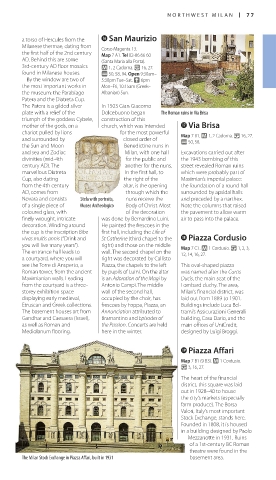
The Milan Stock Exchange in Piazza Affari, built in 1931 basement area.
076-077_EW_Milan.indd 77 20/10/16 3:19 pm

