


Page 87 - (DK Eyewitness) Travel Guide - Milan & The Lakes
P. 87
SOUTHWEST MILAN 85
collection of his bronze and (1,656 ft) long, was one of
coloured plaster sculpture the largest constructions in
pieces and graphic art. the Roman Empire. The only
Largo Carrobbio is at one end remaining parts are the end
of Via Torino, a major commercial curve, visible at the junction
street that developed after the of Via Cappuccio and Via Circo,
merger of the old city districts, and one of the entrance towers,
which were filled with the which became the bell tower of
workshops of oil merchants, silk San Maurizio in Corso Magenta.
weavers, hatters and famous The Circus, active long after
armourers – as is reflected in the fall of the Roman Empire,
the names of some streets. was the venue of the corona-
The 16th-century Palazzo tion of the Lombard king
Stampa, built by Massimiliano Adaloaldo in 615, while in the
Stampa, stands in Via Soncino. Carolingian period it became
When the Sforza dynasty died a vineyard, as the place name
out in 1535, Stampa introduced of nearby Via Vigna indicates.
Spanish dominion to the city At No. 7 Via Cappuccio, the
by hoisting the flag of Charles V 18th-century Palazzo Litta Biumi Fifteenth-century frescoes by the school
on the Castello Sforzesco in has incorporated, to the left of Vincenzo Foppa
exchange for land and privileges. of the central court yard, the
The imperial eagle still stands delightful 15th-century nuns’ 5 San Bernardino
on the palazzo tower, over the convent Santa Maria Maddalena alle Monache
bronze globe representing al Cerchio, which has been
the dominions of Charles V. partly rebuilt. Its name, a Via Lanzone 13. Map 7 A1.
corruption of the Latin ad Tel 02-86 45 08 95. v 2, 3, 14. @ 94.
circulum, refers to the Circus Open 4–6pm Fri, 10am–noon Sun.
over which it was built. The
hood of the nuns’ habit The church is the only remaining
(cappuccio) is probably the building in a Franciscan nuns’
origin of the name of the street convent dating from the mid-
where the convent is located. 15th century and attributed to
Further along, at No. 13, is the Lombard architect Pietro
Palazzo Radice Fossati (a private Antonio Solari. The church was
house), of medieval origin, named after the preacher
with a 13th-century portal and Bernardino da Siena, whose
18th-century frescoes inside. relics are kept here. It was partly
On Via Sant’Orsola you come rebuilt in 1922. The narrow,
to Via Morigi, named after a elegant brick façade is decor-
famous Milanese family who ated with majolica bowls and
once lived here; all that remains a fine elaborate cornice with
of their residence is a 14th- small arches.
The cloister at Santa Maria Maddalena century tower with a small The interior houses fine 15th-
al Cerchio loggia. The nearby square is century frescoes painted by the
domi nated by the 14th-century school of Vincenzo Foppa, and
4 Via Circo Torre dei Gorani, another tower others dating from the early 16th
Map 7 B1. v 2, 3, 14. @ 50, 58. crowned by a loggia with small century. Of note is Madonna
stone columns. and Child with Saint Agnes.
The area extending from Largo
Carrobbio to Corso Magenta is
very rich in 3rd- and 4th-century
ruins, particularly mosaics and
masonry, much of it now part
of private homes. This was
the period when the Roman
emperor Maximian lived in
Milan: his splendid palace was
near Via Brisa. In order to create
a proper imperial capital, he
built many civic edifices to gain
the favour of the Milanese:
the Arena, the thermae and the
huge Circus used for two-horse
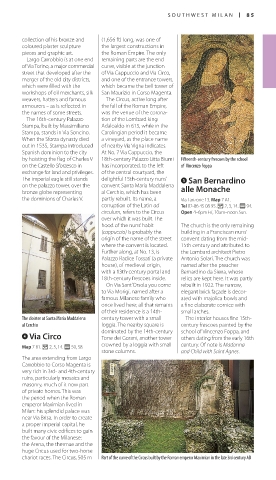
chariot races. The Circus, 505 m Part of the curve of the Circus built by the Roman emperor Maximian in the late 3rd century AD
084-085_EW_Milan.indd 85 20/10/16 3:19 pm

