


Page 92 - (DK Eyewitness) Travel Guide - Milan & The Lakes
P. 92
90 MILAN AREA B Y AREA
by Pascal in 1642, to IBM 8 San Vittore
computers. There is also a al Corpo
section on time measurement,
with a reconstruction of a 1750 Via San Vittore 25. Map 6 F1. Tel 02-
watchmaker’s workshop. The 48 00 53 51. q 2 Sant’Ambrogio.
printing section shows the @ 50, 58, 94. Open 7:30am–noon,
3:30–6pm daily. 5 8am, 6pm Mon–
1810 automatic inking method Fri; 8:30am, 10:30am, noon, 6pm, 9pm
by which 800 sheets an hour Sun; 10am & 6pm hols. 8 available
could be printed, and also for groups (book in advance).
has the father of the modern
typewriter (1855). The original basilica on this site
The cinema photography was founded in the 4th century,
section shows how the claw next to the mausoleum of
device, used to make motion- Emperor Valentinian II, who died
picture film move, grew out in 392. The church was rebuilt in
Old motion picture camera, the Science of a sewing machine needle the 11th and 12th centuries by
and Technology Museum conceived by Singer in 1851. Benedictine monks, and again
In the rooms given over to altered in 1560 by the Olivetans,
7 Museo Nazionale telephones and television, there who replaced the monks.
della Scienza e is a reconstruction of the 1856 The architect (either Alessi or
della Tecnologia pantelegraph, the ancestor Seregni) reversed the orientation
Leonardo da Vinci of the fax machine. and made it one of Milan’s most
sumptuous churches, with
The history of trains begins
Via San Vittore 21. Map 6 F1. with the first locomotive in Italy, splendid late 16th-century
Tel 02-48 55 51. q 2 Sant’Ambrogio. used for the Naples-Portici line paintings. The Baroque Arese
@ 50, 58, 94. Open 9:30am–5pm in 1839, and ends with 1970s Chapel (1668), designed by
Tue–Fri; 9.30am–6:30pm Sat, Sun & models. A pavilion in Via Gerolamo Quad rio, and
hols. & 7 = 0 8 (book at Olona houses the right-hand
Ufficio Didattico). Library, lecture the air and sea apse, with
rooms. ∑ museoscienza.org transport scenes from
section, the life of
The Science and Technology featuring two St Gregory
Museum is housed in the historic pieces: by Camillo
former Olivetan monastery of the bridge Procac cini
San Vittore (16th century) – of the trans- (1602), are
partly designed by Vincenzo atlantic liner Conte Façade detail, San Vittore of particular
Seregni – which became a Biancamano and a al Corpo interest. Moncalvo
military hospital and then naval training ship. frescoed the angel
a barracks after monasteries The Leonardo da Vinci Gallery musicians on the cupola in
were suppressed in 1804. In has fascinating wooden models 1619. The wooden choir stalls,
1947 it became the home of the of the machines and apparatus with carvings of episodes from
museum. In the two courtyards invented by the genius, shown St Benedict’s life, date from
surrounded by the old section together with his drawings. 1583; above them are three
of the museum, you can see Some, like the rotating crane canvases on the same subject
part of the foundation of the and the helical airscrew, which by Giovanni Ambrogio Figino.
San Vittore fortress and that demonstrate principles of Last, the chapel of Sant’Antonio
of the octagonal mausoleum physics and applied mechanics, Abate was entirely frescoed
of Emperor Valentinian II, both can be operated by the public. in 1619 by Daniele Crespi.
ancient Roman.
The museum boasts one
of the world’s leading science
and technology collections.
The vast exhibition space is
housed in different buildings.
The former monastery contains
the technological sections
on metallurgy, casting and
transport, as well as science
sections featuring physics,
optics, acoustics and astro nomy.
Another section shows the
development of calcula tion,
from the first mechanical
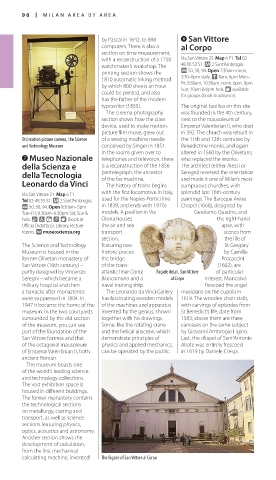
calculating machine, invented The façade of San Vittore al Corpo
090-091_EW_Milan.indd 90 20/10/16 3:19 pm
Eyewitness Travel LAYERS PRINTED:
Catalogue template “UK” LAYER
(Source v2.7)
Date 1st October 2013
Size 125mm x 217mm

