


Page 90 - (DK Eyewitness) Travel Guide - Milan & The Lakes
P. 90
88 MILAN AREA B Y AREA
Exploring Sant’Ambrogio
The Interior
The fact that the church of Sant’Ambrogio houses the The nave provides the best
remains of the city’s patron saint, the church’s founder, view of the interior, revealing
makes it a special place for the Milanese. Most of its the basilica in all its splendour.
present-day appearance is the result of rebuilding in The nave has two side aisles
divided by arcades supporting
the 10th and 12th centuries by the Benedictines from the women’s galleries with piers
the nearby monastery, who made it a model of Lombard with carved capitals. At the
Romanesque religious architecture. All that remains of beginning of the nave is the
the 4th-century basilica are the triumphal arch and its Serpent’s Column, said to have
columns, which became part of the apse. In 1937–40 been erected by Moses in the
desert. Beside it, to the left,
and in the postwar period the Romanesque structure and excavations show the level of
delicate colours were restored. From the Pusterla (gate) the original 4th-century floor.
there is a marvellous view of the church, with its two bell The pulpit (or ambo) is made
towers and atrium, flanked by the rectory and museum. of pieces saved when the
dome collapsed in 1196. This
magnificent monument is
suspended arches, as well decorated with an eagle and
Pusterla di as the proportions, match a seated man, symbols of the
Sant’Ambrogio
those in the church, creating evangelists John and Matthew.
The Pusterla di Sant’Ambrogio, a harmonious continuity Underneath is the sarcophagus
one of the minor gates on between exterior and interior. of Stilicho (4th century) with
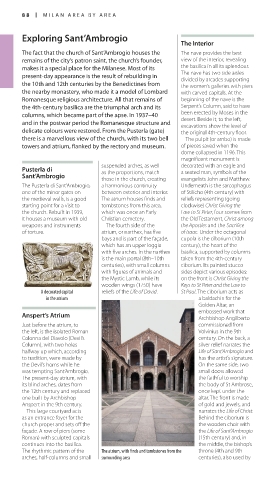
the medieval walls, is a good The atrium houses finds and reliefs representing (going
starting point for a visit to tombstones from this area, clockwise) Christ Giving the
the church. Rebuilt in 1939, which was once an Early Law to St Peter, four scenes from
it houses a museum with old Christian cemetery. the Old Testament, Christ among
weapons and instruments The fourth side of the the Apostles and the Sacrifice
of torture. atrium, or narthex, has five of Isaac. Under the octagonal
bays and is part of the façade, cupola is the ciborium (10th
which has an upper loggia century), the heart of the
with five arches. In the narthex basilica, supported by columns
is the main portal (8th–10th taken from the 4th-century
centuries), with small columns ciborium. Its painted stucco
with figures of animals and sides depict various episodes:
the Mystic Lamb, while its on the front is Christ Giving the
wooden wings (1750) have Keys to St Peter and the Law to
A decorated capital reliefs of the Life of David. St Paul. The ciborium acts as
in the atrium a baldachin for the
Golden Altar, an
embossed work that
Anspert’s Atrium Archbishop Angilberto
Just before the atrium, to commissioned from
the left, is the isolated Roman Volvinius in the 9th
Colonna del Diavolo (Devil’s century. On the back, a
Column), with two holes silver relief narrates the
halfway up which, according Life of Sant’Ambrogio and
to tradition, were made by has the artist’s signature.
the Devil’s horns while he On the same side, two
was tempting Sant’Ambrogio. small doors allowed
The present-day atrium, with the faithful to worship
its blind arches, dates from the body of St Ambrose,
the 12th century and replaced once kept under the
one built by Archbishop altar. The front is made
Anspert in the 9th century. of gold and jewels, and
This large courtyard acts narrates the Life of Christ.
as an entrance foyer for the Behind the ciborium is
church proper and sets off the the wooden choir with
façade. A row of piers (some the Life of Sant’Ambrogio
Roman) with sculpted capitals (15th century) and, in
continues into the basilica. the middle, the bishop’s
The rhythmic pattern of the The atrium, with finds and tombstones from the throne (4th and 9th
arches, half-columns and small surrounding area centuries), also used by
088-089_EW_Milan.indd 88 20/10/16 3:19 pm
Eyewitness Travel LAYERS PRINTED:
Catalogue template “UK” LAYER
(Source v2.7)
Date 1st October 2013
Size 125mm x 217mm

