


Page 134 - The Complete Cat Breed Book (DK)
P. 134
132      C A T AL OG OF BREED S


        HOUSE CAT—SHORTHAIR

        THESE HARDY CATS MAKE EXCELLENT, EASY-TO-KEEP PETS

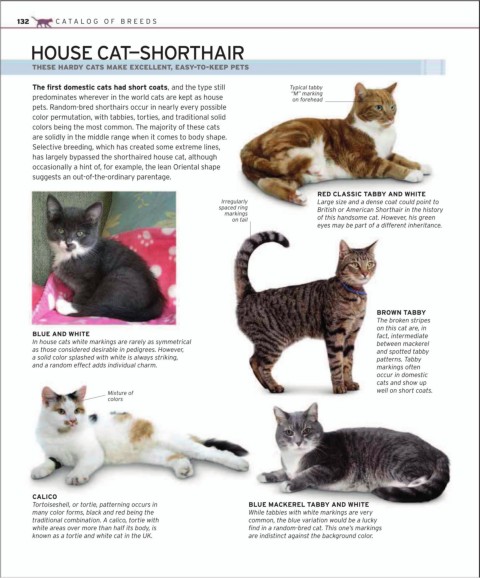
        The first domestic cats had short coats, and the type still   Typical tabby
                                                                    “M” marking
        predominates wherever in the world cats are kept as house   on forehead
        pets. Random-bred shorthairs occur in nearly every possible
        color permutation, with tabbies, torties, and traditional solid
        colors being the most common. The majority of these cats
        are solidly in the middle range when it comes to body shape.
        Selective breeding, which has created some extreme lines,
        has largely bypassed the shorthaired house cat, although
        occasionally a hint of, for example, the lean Oriental shape
        suggests an out-of-the-ordinary parentage.

                                                                          RED CLASSIC TABBY AND WHITE
                                                    Irregularly           Large size and a dense coat could point to
                                                   spaced ring            British or American Shorthair in the history
                                                     markings
                                                      on tail             of this handsome cat. However, his green
                                                                          eyes may be part of a different inheritance.


                                                                                        BROWN TABBY
                                                                                        The broken stripes
                                                                                        on this cat are, in
        BLUE AND WHITE                                                                  fact, intermediate
        In house cats white markings are rarely as symmetrical                          between mackerel
        as those considered desirable in pedigrees. However,                            and spotted tabby
        a solid color splashed with white is always striking,                           patterns. Tabby
        and a random effect adds individual charm.                                      markings often
                                                                                        occur in domestic
                                                                                        cats and show up
                          Mixture of                                                    well on short coats.
                          colors


        CALICO
        Tortoiseshell, or tortie, patterning occurs in    BLUE MACKEREL TABBY AND WHITE
        many color forms, black and red being the         While tabbies with white markings are very
        traditional combination. A calico, tortie with    common, the blue variation would be a lucky
        white areas over more than half its body, is      find in a random-bred cat. This one’s markings
        known as a tortie and white cat in the UK.        are indistinct against the background color.

