


Page 137 - The Complete Cat Breed Book (DK)
P. 137
L ONGHAIRS         135

         LONGHAIRS


         It is thought that long hair in domestic cats arose as a natural
         genetic mutation, most likely in response to cold climates. Where
         this advantageous gene was passed on among cats living in
         isolated areas, such as mountain regions, longhaired populations
         would have arisen. Wild cats with long coats are a rarity and
                                                                                 The curly coated Selkirk Rex
         have no role in the ancestry of domestic longhairs.                    longhair is an unusual variation


         Types of longhair               native to North America. Huge and   appearance. Frequent grooming—
         The first longhaired cats seen in   handsome, this breed has a shaggy   a daily session may be needed in
         Western Europe arrived some time    look due to the variable length of    some breeds—keeps loose hairs to
         in the 16th century. These were the   the hair in its topcoat. Almost equally   a minimum and prevents the thick
         Angoras, a slender, silky-coated Turkish   striking is the big blue-eyed Ragdoll,   undercoat from matting.
         breed that enjoyed a certain popularity   while the brush-tailed Somali has
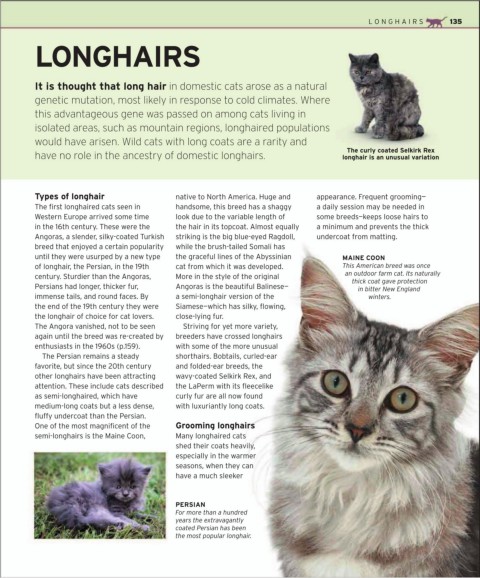
         until they were usurped by a new type   the graceful lines of the Abyssinian   MAINE COON
         of longhair, the Persian, in the 19th   cat from which it was developed.   This American breed was once
                                                                                 an outdoor farm cat. Its naturally
         century. Sturdier than the Angoras,   More in the style of the original
                                                                                  thick coat gave protection
         Persians had longer, thicker fur,   Angoras is the beautiful Balinese—     in bitter New England
         immense tails, and round faces. By    a semi-longhair version of the         winters.
         the end of the 19th century they were   Siamese—which has silky, flowing,
         the longhair of choice for cat lovers.   close-lying fur.
         The Angora vanished, not to be seen   Striving for yet more variety,
         again until the breed was re-created by   breeders have crossed longhairs
         enthusiasts in the 1960s (p.159).   with some of the more unusual
           The Persian remains a steady   shorthairs. Bobtails, curled-ear
         favorite, but since the 20th century   and folded-ear breeds, the
         other longhairs have been attracting   wavy-coated Selkirk Rex, and
         attention. These include cats described   the LaPerm with its fleecelike
         as semi-longhaired, which have   curly fur are all now found
         medium-long coats but a less dense,   with luxuriantly long coats.
         fluffy undercoat than the Persian.
         One of the most magnificent of the   Grooming longhairs
         semi-longhairs is the Maine Coon,   Many longhaired cats
                                         shed their coats heavily,
                                         especially in the warmer
                                         seasons, when they can
                                         have a much sleeker


                                         PERSIAN
                                         For more than a hundred
                                         years the extravagantly
                                         coated Persian has been
                                         the most popular longhair.

