


Page 20 - The Complete Cat Breed Book (DK)
P. 20
18      INTR ODUC TION T O C A T S


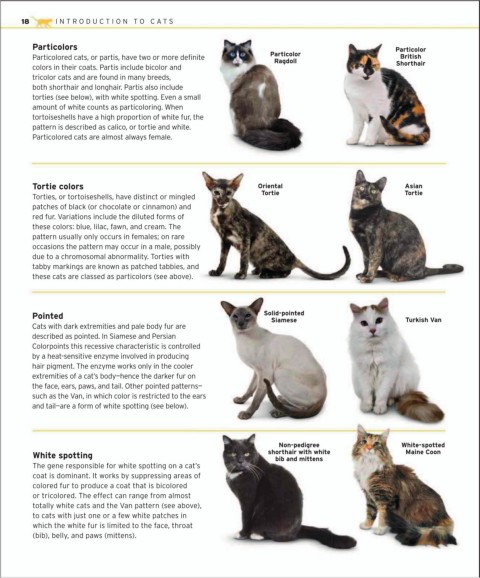
        Particolors                                                                         Particolor
                                                               Particolor
        Particolored cats, or partis, have two or more definite                               British
                                                                Ragdoll                     Shorthair
        colors in their coats. Partis include bicolor and
        tricolor cats and are found in many breeds,
        both shorthair and longhair. Partis also include
        torties (see below), with white spotting. Even a small
        amount of white counts as particoloring. When
        tortoiseshells have a high proportion of white fur, the
        pattern is described as calico, or tortie and white.
        Particolored cats are almost always female.


        Tortie colors                                       Oriental                          Asian
                                                             Tortie                           Tortie
        Torties, or tortoiseshells, have distinct or mingled
        patches of black (or chocolate or cinnamon) and
        red fur. Variations include the diluted forms of
        these colors: blue, lilac, fawn, and cream. The
        pattern usually only occurs in females; on rare
        occasions the pattern may occur in a male, possibly
        due to a chromosomal abnormality. Torties with
        tabby markings are known as patched tabbies, and
        these cats are classed as particolors (see above).


        Pointed                                               Solid-pointed
                                                               Siamese                        Turkish Van
        Cats with dark extremities and pale body fur are
        described as pointed. In Siamese and Persian
        Colorpoints this recessive characteristic is controlled
        by a heat-sensitive enzyme involved in producing
        hair pigment. The enzyme works only in the cooler
        extremities of a cat’s body—hence the darker fur on
        the face, ears, paws, and tail. Other pointed patterns—
        such as the Van, in which color is restricted to the ears
        and tail—are a form of white spotting (see below).


                                                                 Non-pedigree                 White-spotted
        White spotting                                         shorthair with white           Maine Coon
                                                                bib and mittens
        The gene responsible for white spotting on a cat’s
        coat is dominant. It works by suppressing areas of
        colored fur to produce a coat that is bicolored
        or tricolored. The effect can range from almost
        totally white cats and the Van pattern (see above),
        to cats with just one or a few white patches in
        which the white fur is limited to the face, throat
        (bib), belly, and paws (mittens).

