


Page 15 - The Complete Cat Breed Book (DK)
P. 15
WHA T IS A C A T?        13

         which patrol much smaller ranges. Domestic cats are    A cat’s eyes are highly sensitive to small movements but their
         also a little smaller than their wild cousins.   color vision is poor, since cats are primarily nocturnal animals.
           Being carnivores, cats have a relatively short intestinal   Cats have a wider range of hearing than humans, enabling
         tract, because it is easier to digest meat than plant matter.    them to detect the high-pitched squeaks of rodents. In addition
         A domestic cat’s tract is a little longer than that of a wildcat.   to acute senses of taste and smell, cats have a sensory organ
         This reflects dietary changes—primarily the cereal content in   in the roof of the mouth—the vomeronasal, or Jacobson’s,
         food scraps scavenged from humans over millennia.   organ. To use this organ, cats contort their face (an action
           Cats have scent-producing glands in the skin around    called the Flehmen response) as they pick up scents—usually
         the mouth and tail, and also on the paws. They mark their   those left by other cats. The several sets of whiskers on the
         territory using these scents and by scratching surfaces.   face are highly sensitive to touch and air currents.


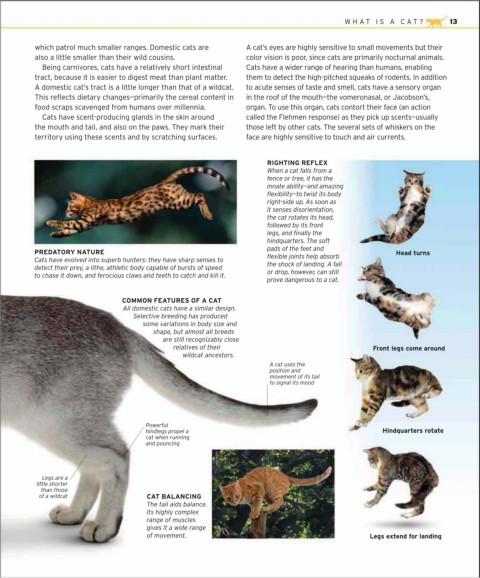
                                                               RIGHTING REFLEX
                                                               When a cat falls from a
                                                               fence or tree, it has the
                                                               innate ability—and amazing
                                                               flexibility—to twist its body
                                                               right-side up. As soon as
                                                               it senses disorientation,
                                                               the cat rotates its head,
                                                               followed by its front
                                                               legs, and finally the
                                                               hindquarters. The soft
                                                               pads of the feet and
         PREDATORY NATURE                                                                   Head turns
         Cats have evolved into superb hunters: they have sharp senses to   flexible joints help absorb
         detect their prey, a lithe, athletic body capable of bursts of speed    the shock of landing. A fall
         to chase it down, and ferocious claws and teeth to catch and kill it.  or drop, however, can still
                                                               prove dangerous to a cat.

                             COMMON FEATURES OF A CAT
                             All domestic cats have a similar design.
                                Selective breeding has produced
                                  some variations in body size and
                                    shape, but almost all breeds
                                      are still recognizably close
                                         relatives of their                            Front legs come around
                                           wildcat ancestors.
                                                               A cat uses the
                                                               position and
                                                               movement of its tail
                                                               to signal its mood


                                   Powerful
                                   hindlegs propel a                                     Hindquarters rotate
                                   cat when running
                                   and pouncing


           Legs are a
         little shorter
          than those
          of a wildcat             CAT BALANCING
                                   The tail aids balance.
                                   Its highly complex
                                   range of muscles
                                   gives it a wide range
                                   of movement.                                       Legs extend for landing

