


Page 16 - The Complete Cat Breed Book (DK)
P. 16
14      INTR ODUC TION T O C A T S


        Body shapes
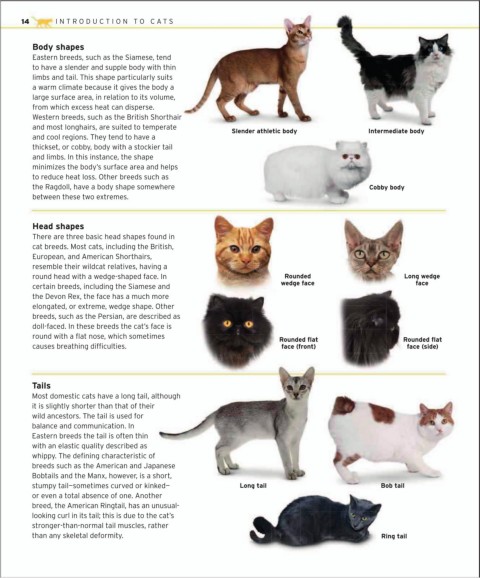
        Eastern breeds, such as the Siamese, tend
        to have a slender and supple body with thin
        limbs and tail. This shape particularly suits
        a warm climate because it gives the body a
        large surface area, in relation to its volume,
        from which excess heat can disperse.
        Western breeds, such as the British Shorthair
        and most longhairs, are suited to temperate
                                                      Slender athletic body           Intermediate body
        and cool regions. They tend to have a
        thickset, or cobby, body with a stockier tail
        and limbs. In this instance, the shape
        minimizes the body’s surface area and helps
        to reduce heat loss. Other breeds such as
        the Ragdoll, have a body shape somewhere                                      Cobby body
        between these two extremes.


        Head shapes
        There are three basic head shapes found in
        cat breeds. Most cats, including the British,
        European, and American Shorthairs,
        resemble their wildcat relatives, having a
        round head with a wedge-shaped face. In                    Rounded                    Long wedge
                                                                  wedge face                     face
        certain breeds, including the Siamese and
        the Devon Rex, the face has a much more
        elongated, or extreme, wedge shape. Other
        breeds, such as the Persian, are described as
        doll-faced. In these breeds the cat’s face is
        round with a flat nose, which sometimes
                                                                 Rounded flat                 Rounded flat
        causes breathing difficulties.                             face (front)                 face (side)


        Tails
        Most domestic cats have a long tail, although
        it is slightly shorter than that of their
        wild ancestors. The tail is used for
        balance and communication. In
        Eastern breeds the tail is often thin
        with an elastic quality described as
        whippy. The defining characteristic of
        breeds such as the American and Japanese
        Bobtails and the Manx, however, is a short,
        stumpy tail—sometimes curved or kinked—         Long tail                        Bob tail
        or even a total absence of one. Another
        breed, the American Ringtail, has an unusual-
        looking curl in its tail; this is due to the cat’s
        stronger-than-normal tail muscles, rather
        than any skeletal deformity.                                                     Ring tail

