


Page 242 - The Complete Cat Breed Book (DK)
P. 242
240       HEAL TH AND BREEDING


        Common health problems
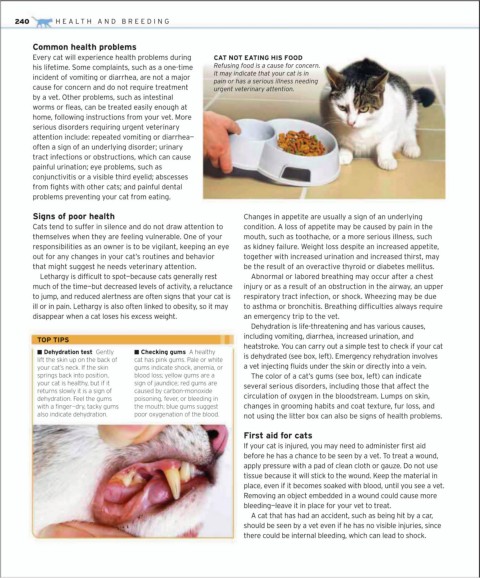
        Every cat will experience health problems during   CAT NOT EATING HIS FOOD
        his lifetime. Some complaints, such as a one-time   Refusing food is a cause for concern.
                                                  It may indicate that your cat is in
        incident of vomiting or diarrhea, are not a major
                                                  pain or has a serious illness needing
        cause for concern and do not require treatment   urgent veterinary attention.
        by a vet. Other problems, such as intestinal
        worms or fleas, can be treated easily enough at
        home, following instructions from your vet. More
        serious disorders requiring urgent veterinary
        attention include: repeated vomiting or diarrhea—
        often a sign of an underlying disorder; urinary
        tract infections or obstructions, which can cause
        painful urination; eye problems, such as
        conjunctivitis or a visible third eyelid; abscesses
        from fights with other cats; and painful dental
        problems preventing your cat from eating.

        Signs of poor health                             Changes in appetite are usually a sign of an underlying
        Cats tend to suffer in silence and do not draw attention to   condition. A loss of appetite may be caused by pain in the
        themselves when they are feeling vulnerable. One of your   mouth, such as toothache, or a more serious illness, such
        responsibilities as an owner is to be vigilant, keeping an eye   as kidney failure. Weight loss despite an increased appetite,
        out for any changes in your cat’s routines and behavior    together with increased urination and increased thirst, may
        that might suggest he needs veterinary attention.  be the result of an overactive thyroid or diabetes mellitus.
          Lethargy is difficult to spot—because cats generally rest   Abnormal or labored breathing may occur after a chest
        much of the time—but decreased levels of activity, a reluctance   injury or as a result of an obstruction in the airway, an upper
        to jump, and reduced alertness are often signs that your cat is   respiratory tract infection, or shock. Wheezing may be due
        ill or in pain. Lethargy is also often linked to obesity, so it may   to asthma or bronchitis. Breathing difficulties always require
        disappear when a cat loses his excess weight.    an emergency trip to the vet.
                                                           Dehydration is life-threatening and has various causes,
                                                         including vomiting, diarrhea, increased urination, and
          TOP TIPS
                                                         heatstroke. You can carry out a simple test to check if your cat
          ■     Dehydration test  Gently   ■     Checking gums  A healthy
          lift the skin up on the back of   cat has pink gums. Pale or white   is dehydrated (see box, left). Emergency rehydration involves
          your cat’s neck. If the skin   gums indicate shock, anemia, or   a vet injecting fluids under the skin or directly into a vein.
          springs back into position,    blood loss; yellow gums are a   The color of a cat’s gums (see box, left) can indicate
          your cat is healthy, but if it   sign of jaundice; red gums are   several serious disorders, including those that affect the
          returns slowly it is a sign of   caused by carbon-monoxide
          dehydration. Feel the gums    poisoning, fever, or bleeding in   circulation of oxygen in the bloodstream. Lumps on skin,
          with a finger—dry, tacky gums   the mouth; blue gums suggest    changes in grooming habits and coat texture, fur loss, and
          also indicate dehydration.  poor oxygenation of the blood.  not using the litter box can also be signs of health problems.

                                                         First aid for cats
                                                         If your cat is injured, you may need to administer first aid
                                                         before he has a chance to be seen by a vet. To treat a wound,
                                                         apply pressure with a pad of clean cloth or gauze. Do not use
                                                         tissue because it will stick to the wound. Keep the material in
                                                         place, even if it becomes soaked with blood, until you see a vet.
                                                         Removing an object embedded in a wound could cause more
                                                         bleeding—leave it in place for your vet to treat.
                                                           A cat that has had an accident, such as being hit by a car,
                                                         should be seen by a vet even if he has no visible injuries, since
                                                         there could be internal bleeding, which can lead to shock.

