


Page 240 - The Complete Cat Breed Book (DK)
P. 240
238       HEAL TH AND BREEDING


        HEALTH


        Your greatest responsibility as an owner is your cat’s health.
        You must ensure that your pet has regular checkups and
        vaccinations, and be able to recognize any changes in his body
        or behavior that may require a trip to the vet. Educate yourself
        about common disorders and learn how to care for your cat
                                                                                     Keep your cat free
        when he is ill, recovering from surgery, or in an emergency.                 of itchy parasites


        Finding and visiting a vet
        Before bringing a cat home, look for a veterinary practice
        that will be willing to treat your cat. Your cat breeder may be
        able to recommend one. Alternatively, ask friends with cats
        or consult a local cat club or rescue center. Going to the vet
        is stressful for most cats, because they encounter strangers
        and other animals. Even a well-socialized cat will feel uneasy
        during the visit. Always take your cat in a carrier, with its
        door kept facing you in the waiting room so that he can see
        you. Speak to him soothingly and reward him with
        treats afterward.
          If you buy a pedigree kitten, he should already have had
        his first vaccinations before you take him home at about 12
        weeks old. Your breeder will give you the kitten’s vaccination
        certificate, which you should show the vet on your initial
        visit. One of your earliest visits may be to have your cat
        neutered, generally from four months of age.


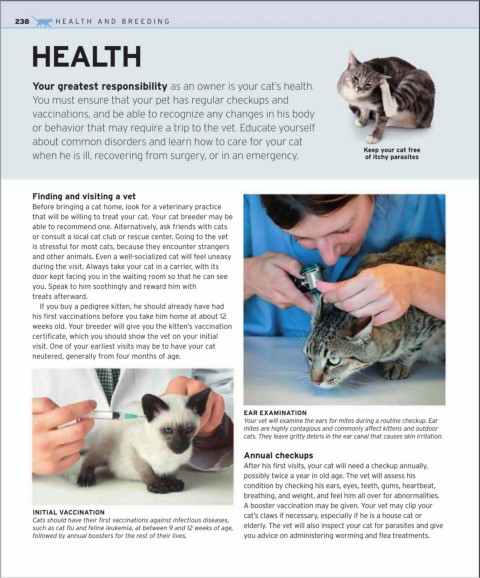
                                                         EAR EXAMINATION
                                                         Your vet will examine the ears for mites during a routine checkup. Ear
                                                         mites are highly contagious and commonly affect kittens and outdoor
                                                         cats. They leave gritty debris in the ear canal that causes skin irritation.

                                                         Annual checkups
                                                         After his first visits, your cat will need a checkup annually,
                                                         possibly twice a year in old age. The vet will assess his
                                                         condition by checking his ears, eyes, teeth, gums, heartbeat,
                                                         breathing, and weight, and feel him all over for abnormalities.
                                                         A booster vaccination may be given. Your vet may clip your
        INITIAL VACCINATION                              cat’s claws if necessary, especially if he is a house cat or
        Cats should have their first vaccinations against infectious diseases,
        such as cat flu and feline leukemia, at between 9 and 12 weeks of age,   elderly. The vet will also inspect your cat for parasites and give
        followed by annual boosters for the rest of their lives.  you advice on administering worming and flea treatments.

