


Page 78 - All About History - Issue 180-19
P. 78
Greatest Battles
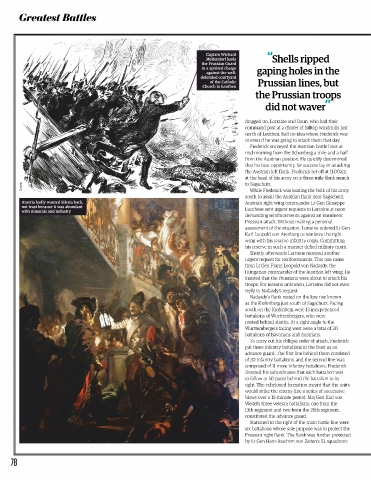
Captain Wichard
Mollendorf leads “Shells ripped
the Prussian Guard
in a spirited charge gaping holes in the
against the well-
defended courtyard
of the Catholic Prussian lines, but
Church in Leuthen
the Prussian troops
did not waver”
dragged on, Lorraine and Daun, who had their
command post at a cluster of hilltop windmills just
north of Leuthen, had no idea where Frederick was
or even if he was going to attack them that day.
Frederick surveyed the Austrian battle lines at
mid-morning from the Schonberg a mile and a half
from the Austrian position. He quickly determined
that his best opportunity for success lay in attacking
the Austrian left flank. Frederick set off at 11.00am
at the head of his army on a three-mile flank march
© Alamy to Sagschutz.
While Frederick was leading the bulk of his army
south to assail the Austrian flank near Sagschutz,
Austria badly wanted Silesia back, Austrian right wing commander Lt Gen Giuseppe
not least because it was abundant Lucchese sent urgent requests to Lorraine at noon
with minerals and industry
demanding reinforcements against an imminent
Prussian attack. Without making a personal
assessment of the situation, Lorraine ordered Lt Gen
Karl Leopold von Arenberg to reinforce the right
wing with his reserve infantry corps. Committing
his reserve in such a manner defied military norm.
Shortly afterwards Lorraine received another
urgent request for reinforcements. This one came
from Lt Gen Franz Leopold von Nadasdy, the
Hungarian commander of the Austrian left wing. He
insisted that the Prussians were about to attack his
troops. For reasons unknown, Lorraine did not even
reply to Nadasdy’s request.
Nadasdy’s flank rested on the low rise known
as the Kiefenberg just south of Sagschutz. Facing
south on the Kiefenberg were 13 inexperienced
battalions of Wurttembergers, who were
posted behind abattis. At a right angle to the
Wurttembergers facing west were a total of 20
battalions of Bavarians and Austrians.
To carry out his oblique order of attack, Frederick
put three infantry battalions in the front as an
advance guard. The first line behind them consisted
of 20 infantry battalions, and the second line was
composed of 11 more infantry battalions. Frederick
directed his subordinates that each battalion was
to follow at 50 paces behind the battalion to its
right. The echeloned formation meant that the units
would strike the enemy line a series of successive
blows over a 15-minute period. Maj Gen Karl von
Wedel’s three veteran battalions, one from the
13th regiment and two from the 26th regiment,
constituted the advance guard.
Stationed to the right of the main battle line were
six battalions whose sole purpose was to protect the
Prussian right flank. The flank was further protected
by Lt Gen Hans Joachim von Zieten’s 53 squadrons
78

