


Page 79 - All About History - Issue 180-19
P. 79
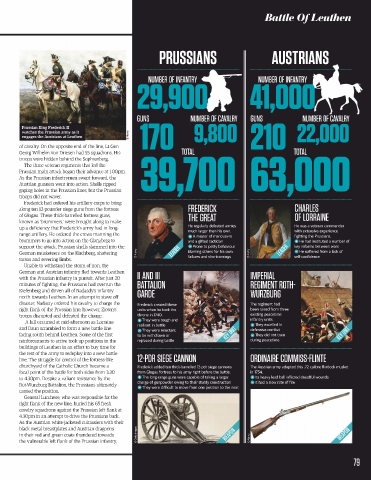
Battle Of Leuthen


                                                                             Prussians                                             austrians


                                                                        numBer of infantry
                                                                                                                             numBer of infantry
                                                                   29,900                                                41,000


                                                                   GunS                     numBer of cavalry            GunS                     numBer of cavalry

            Prussian King Frederick II
            watches the Prussian army as it                         170                       9,800                      210                   22,000
            engages the Austrians at Leuthen                   © Alamy

          of cavalry. On the opposite end of the line, Lt Gen                           total                                                 total
          gaping holes in the Prussian lines, but the Prussian 39,700 63,000
          Georg Wilhelm von Driesen had 55 squadrons. His
          troops were hidden behind the Sophienberg.
             The three veteran regiments that led the
          Prussian main attack began their advance at 1.00pm.
          As the Prussian infantrymen swept forward, the
          Austrian gunners went into action. Shells ripped


          troops did not waver.
             Frederick had ordered his artillery corps to bring
          along ten 12-pounder siege guns from the fortress                                frederick                                          charleS
          of Glogau. These thick-barrelled fortress guns,                                  the Great                                          of lorraine
          known as ‘brummers,’ were brought along to make
          up a deficiency that Frederick’s army had in long-                               He regularly defeated armies                       He was a veteran commander
                                                                                           much larger than his own.
                                                                                                                                              with extensive experience
          range artillery. He ordered the crews manning the                                   A master of manouevre                           fighting the Prussians.
          brummers to go into action on the Glanzberg to                                   and a gifted tactician                               He had instituted a number of
          support the attack. Prussian shells slammed into the                                Prone to petty behaviour                        key reforms between wars
          German musketeers on the Kirchberg, shattering          © Alamy          leader  blaming others for his own   © Alamy        leader   He suffered from a lack of
          torsos and severing limbs.                                                       failures and shortcomings                          self-confidence
             Unable to withstand the storm of iron, the
          German and Austrian infantry fled towards Leuthen
          with the Prussian infantry in pursuit. After just 20     ii and iii                                            imperial
          minutes of fighting, the Prussians had overrun the       Battalion                                             reGimentroth-
          Kiefenberg and driven all of Nadasdy’s infantry          Garde                                                 WurzBurG
          north towards Leuthen. In an attempt to stave off
          disaster, Nadasty ordered his cavalry to charge the      Frederick created these                               The regiment had
          right flank of the Prussian line; however, Zieten’s      units when he took the                                been raised from three
          troops disrupted and defeated the charge.                throne in 1740.                                       existing peacetime
                                                                     They were tough and
             A lull occurred at mid-afternoon as Lorraine          resilient in battle                                   infantry units.
                                                                                                                           They excelled in
          and Daun scrambled to form a new battle line               They were reluctant                                 defensive combat
          facing south behind Leuthen. Some of the first           to be withdrawn or                        key unit      They did not train                       key unit
          reinforcements to arrive took up positions in the        replaced during battle                                during peacetime
          buildings of Leuthen in an effort to buy time for
          the rest of the army to redeploy into a new battle
          line. The struggle for control of the fortress-like      12-pdr SieGe cannon                                   ordinaire commiSS-flinte
          churchyard of the Catholic Church became a               Frederick added ten thick-barrelled 12-pdr siege cannons  The Austrian army adopted this .72 calibre flintlock musket
          focal point of the battle for both sides from 3.30       from Glogau fortress to his army right before the battle.  in 1754.
          to 4.30pm. Despite a valiant resistance by the             The long-range guns were capable of taking a larger   Its heavy lead ball inflicted dreadful wounds
          Rot-Wurzburg Battalion, the Prussians ultimately         charge of gunpowder owing to their sturdy construction  It had a slow rate of fire
                                                                     They were difficult to move from one position to the next
          carried the position.
             General Lucchese, who was responsible for the
          right flank of the new line, hurled his 65 fresh
          cavalry squadrons against the Prussian left flank at
          4.30pm in an attempt to drive the Prussians back.
          As the Austrian white-jacketed cuirassiers with their
          black metal breastplates and Austrian dragoons
          in their red and green coats thundered towards          © Getty Images                             Weapon                                                 Weapon
          the vulnerable left flank of the Prussian infantry,                                                            © Alamy


                                                                                                                                                                           79

