


Page 80 - All About History - Issue 180-19
P. 80
Greatest Battles


          intercepted the Austrians, they soon became hard- 5dec1757
          Prussian left wing cavalry commander Driesen
          waved his first line into action.
             Driesen’s first line consisted of 10 squadrons of
          the vaunted Bayreuth Dragoons. Although they


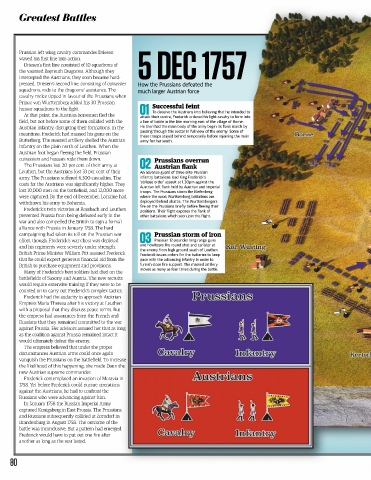
          pressed. Driesen’s second line, consisting of cuirassier  How the Prussians defeated the
          squadrons, rode to the dragoons’ assistance. The         much larger Austrian force
          cavalry melee tipped in favour of the Prussians when
          Prince von Wurttemberg added his 30 Prussian
          hussar squadrons to the fight.                            01    Successful feint
                                                                          To deceive the Austrians into believing that he intended to
             At that point, the Austrian horsemen fled the          attack their centre, Frederick ordered his light cavalry to form into
          field, but not before some of them collided with the      a line of battle in the late morning east of the village of Borne.
          Austrian infantry, disrupting their formations. In the    He then had the main body of the army begin its flank march by
          meantime, Frederick had massed his guns on the            passing through this sector in full view of the enemy. Some of
                                                                    these troops stayed behind temporarily before rejoining the main
          Butterberg. The massed artillery shelled the Austrian     army further south.
          infantry on the plain north of Leuthen. When the
          Austrian foot began fleeing the field, Prussian
          cuirassiers and hussars rode them down.                          Prussians overrun
             The Prussians lost 20 per cent of their army at        02 Austrian flank
          Leuthen, but the Austrians lost 33 per cent of their      An advance guard of three elite Prussian
          army. The Prussians suffered 6,300 casualties. The        infantry battalions lead King Frederick’s
          costs for the Austrians was significantly higher. They    ‘oblique order’ assault at 1.30pm against the
                                                                    Austrian left flank held by Austrian and Imperial
          lost 10,000 men on the battlefield, and 12,000 more       troops. The Prussians storm the Kiefenberg
          were captured. By the end of December, Lorraine had       where the weak Wurttemberg battalions are
          withdrawn his army to Bohemia.                            deployed behind abattis. The Wurttembergers
             Frederick’s twin victories at Rossbach and Leuthen     fire on the Prussians briefly before fleeing their
                                                                    positions. Their flight exposes the flank of
          prevented Prussia from being defeated early in the        other battalions which soon join the flight.
          war and also compelled the British to sign a formal
          alliance with Prussia in January 1758. The hard
          campaigning had taken its toll on the Prussian war        03     Prussian storm of iron
          effort, though. Frederick’s war chest was depleted               Prussian 12-pounder long-range guns
          and his regiments were severely under strength.           and howitzers fire round shot and canister at
                                                                    the enemy from high ground south of Leuthen.
          British Prime Minister William Pitt assured Frederick     Frederick issues orders for the batteries to keep
          that he could expect generous financial aid from the      pace with the advancing infantry in order to
          British to purchase equipment and provisions.             furnish close fire support. The massed artillery
             Many of Frederick’s best soldiers had died on the      moves as many as four times during the battle.
          battlefields of Saxony and Austria. The new recruits
          would require extensive training if they were to be
          counted on to carry out Frederick’s complex tactics.
             Frederick had the audacity to approach Austrian
          Empress Maria Theresa after his victory at Leuthen
          with a proposal that they discuss peace terms. But
          the empress had assurances from the French and
          Russians that they remained committed to the war
          against Prussia. Her advisors assured her that as long
          as the coalition against Prussia remained intact it
          would ultimately defeat the enemy.
             The empress believed that under the proper
          circumstances Austrian arms could once again
          vanquish the Prussians on the battlefield. To increase
          the likelihood of this happening, she made Daun the
          new Austrian supreme commander.
             Frederick contemplated an invasion of Moravia in
          1758. Yet before Frederick could pursue operations
          against the Austrians, he had to confront the
          Russians who were advancing against him.
             In January 1758 the Russian Imperial Army
          captured Konigsberg in East Prussia. The Prussians
          and Russians subsequently collided at Zorndorf in
          Brandenburg in August 1758. The outcome of the
          battle was inconclusive. But a pattern had emerged.
          Frederick would have to put out one fire after
          another as long as the war lasted.


      80

