


Page 166 - (DK Eyewitness) Travel Guide - Southwest USA & National Parks
P. 166
164 the four c orners introducing the four c orners 165
The Ancestral Puebloans Where to Find
the hauntingly beautiful and elaborate ruins left behind by Ancestral
the Ancestral Puebloan people are a key factor in the hold Puebloan Ruins
that this ancient culture has over the public imagination. Canyon de Chelly National
Also known as “Anasazi,” a name coined by the navajo Monument (p172);
meaning “Ancient enemy Ancestor,” today they are more Chaco Culture National
Historical Park (p178);
accurately known as the Ancestral Puebloan people, and Mesa Verde National Park
are seen as the ancestors of today’s Pueblo peoples. (p184); Navajo National
the first Ancestral Puebloans (see p42) are thought to have Monument (p170);
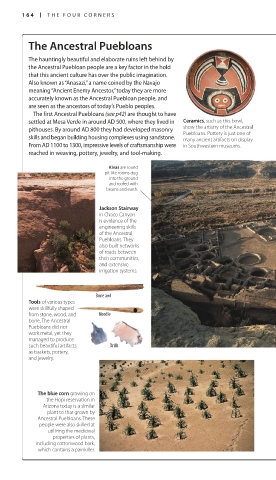
settled at Mesa Verde in around AD 500, where they lived in Ceramics, such as this bowl, The kiva was the religious and ceremonial center of Ancestral Puebloan Hovenweep National
Monument (p176); and
pithouses. By around AD 800 they had developed masonry show the artistry of the Ancestral life. Still used by modern Pueblo Indians today, a kiva usually had no Aztec Ruins National
Puebloans. Pottery is just one of
windows and the only access was through a hole in the roof. Small kivas
skills and began building housing complexes using sandstone. many ancient artifacts on display were used by a single family unit, while large ones were designed to Monument (p177).
from AD 1100 to 1300, impressive levels of craftsmanship were in Southwestern museums. accommodate the whole community.
reached in weaving, pottery, jewelry, and tool-making.
Petroglyphs were
Kivas are round often used by
pit-like rooms dug Ancestral Puebloans as
into the ground
and roofed with astronomical markers
beams and earth. for the different
seasons. This one was
found at the Petrified
Jackson Stairway Forest National Park in
in Chaco Canyon Arizona (see p77).
is evidence of the
engineering skills Pueblo Bonito features
of the Ancestral many examples of the
Puebloans. They masonry skills used by
also built networks the Puebloan peoples.
of roads between
their communities,
and extensive The Pueblo People
irrigation systems. By AD 1300 the Ancestral Puebloans had
abandoned many of their long-established
settlement sites and migrated to areas
where new centers emerged. Theories
Bone awl on why this occurred include a 50-year
Tools of various types drought; the strain that a larger population
were skillfully shaped placed on the desert’s limited resources; and
from stone, wood, and Needle a lengthy period of social upheaval, perhaps
bone. The Ancestral stimulated by increasing trade with tribes as
Puebloans did not far away as central Mexico. Archaeologists
work metal, yet they agree that the Ancestral Puebloans did not
managed to produce disappear but live on today in Puebloan
such beautiful artifacts Drills descendants who trace their origins to
as baskets, pottery, Mesa Verde, Chaco, and other sacred
and jewelry. Chaco Canyon’s Pueblo Bonito ancestral sites.
At Chaco Canyon (see pp178–9), the largest
“great house” ever built was Pueblo Bonito with
more than 600 rooms and 40 kivas. One current
theory is that these structures did not house
The blue corn growing on populations but were, in fact, public buildings for
the Hopi reservation in commerce and ceremonial gatherings. The lives
Arizona today is a similar of the Ancestral Puebloans were short, barely
plant to that grown by 35 years, and as harsh as the environment in
Ancestral Puebloans. These which they lived. Their diet was poor, and arthritis
people were also skilled at and dental problems were common. Women
utilizing the medicinal often showed signs of osteoporosis or brittle
properties of plants, bones as early as their first childbirth. Painstaking excavation at an Ancestral Puebloan kiva in
including cottonwood bark, Chaco Canyon
which contains a painkiller.
164-SWUS-AT992-1137-S5F1.indd 164 09/02/16 10:48 am 164-SWUS-AT992-1137-S5F1.indd 165 09/02/16 10:48 am
Eyewitness Travel LAYERS PRINTED:
Feature template “UK” LAYER
(SourceReport v1.3)
Date 18th October 2012
Size 125mm x 217mm

