


Page 192 - (DK Eyewitness) Travel Guide - Southwest USA & National Parks
P. 192
190 NE W MEXIC O INTRODUCING NE W MEXIC O 191
The Atomic Age Dr. John P. Stapp testing acceleration in his
Sonic Wind I rocket sled in 1954 at Holloman Air
Force Base near White Sands Missile Range. His
During World War II, fears that the Germans were developing research improved aircraft seatbelt technology.
an atomic bomb led the US to begin its own nuclear weapons
program. In 1942 Britain and the US combined their research
efforts; Los Alamos was chosen as the location for the
Manhattan Project, which resulted in the world’s first nuclear
explosion in July 1945. The clear skies, level ground, and sparse
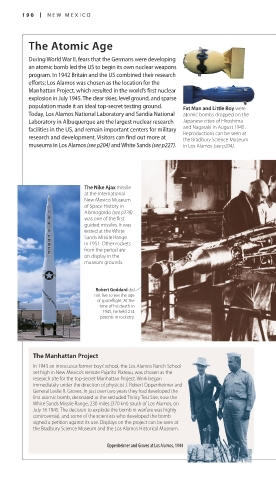
population made it an ideal top-secret testing ground. Fat Man and Little Boy were
Today, Los Alamos National Laboratory and Sandia National atomic bombs dropped on the
Labor atory in Albuquerque are the largest nuclear research Japanese cities of Hiroshima Ham the space chimp is
facilities in the US, and remain important centers for military and Nagasaki in August 1945. Goddard’s assistants (left helped out of his capsule
Reproductions can be seen at
to right) in his workshop
after becoming the first
research and development. Visitors can find out more at the Bradbury Science Museum were N. T. Ljungquist, A. W. living creature to be sent
museums in Los Alamos (see p204) and White Sands (see p227). in Los Alamos (see p204). Kisk, and C. W. Mansur. into space in 1961.
Rocket Science
Robert H. Goddard (1882–1945) is often
referred to as “the father of modern rocketry,”
The Nike Ajax missile developing rocket science in his workshop
at the International in Roswell, New Mexico (see p231). He
New Mexico Museum launched his first liquid-fueled rocket in
of Space History in Massachusetts in 1926 and performed 56
Alamogordo (see p228) flight tests in Roswell in the 1930s. By 1935
was one of the first he had developed rockets that could carry
guided missiles. It was cameras and record instrument readings.
tested at the White An altitude record was set in 1937, when
Sands Missile Range a Goddard rocket reached 2 miles (3 km)
in 1951. Other rockets above the earth.
from the period are
on display in the
museum grounds.
Robert Goddard did
not live to see the age
of spaceflight. At the
time of his death in
1945, he held 214
patents in rocketry.
A Goddard rocket
The Manhattan Project without its casing, The space shuttle touching down on the
being studied on
In 1943 an innocuous former boys’ school, the Los Alamos Ranch School an “assembly frame.” Northrup strip at the White Sands Missile
set high in New Mexico’s remote Pajarito Plateau, was chosen as the Range on March 30, 1982. This was the first
research site for the top-secret Manhattan Project. Work began time in its three-flight history that the shuttle
immediately under the direction of physicist J. Robert Oppenheimer and landed in New Mexico. The shuttle program
General Leslie R. Groves. In just over two years they had developed the ended in 2011, but White Sands remains a
first atomic bomb, detonated at the secluded Trinity Test Site, now the designated missile testing ground.
White Sands Missile Range, 230 miles (370 km) south of Los Alamos, on
July 16 1945. The decision to explode the bomb in warfare was highly New Mexico’s role in space, including astronaut
controversial, and some of the scientists who developed the bomb training, is featured in the New Mexico Museum
signed a petition against its use. Displays on the project can be seen at of Space History (p228). Here astronaut Steven
the Bradbury Science Museum and the Los Alamos Historical Museum. Robinson is training in a buoyancy tank to
simulate life in space in preparation for his 1998
mission on the Discovery shuttle.
Oppenheimer and Groves at Los Alamos, 1944
190-191_EW_SW_USA.indd 190 28/11/17 12:41 PM 190-191_EW_SW_USA.indd 191 28/11/17 12:41 PM
Eyewitness Travel LAYERS PRINTED:
Feature template “UK” LAYER
(SourceReport v1.3)
Date 18th October 2012
Size 125mm x 217mm

