


Page 194 - (DK Eyewitness) Travel Guide - Southwest USA & National Parks
P. 194
192 NE W MEXIC O INTRODUCING NE W MEXIC O 193
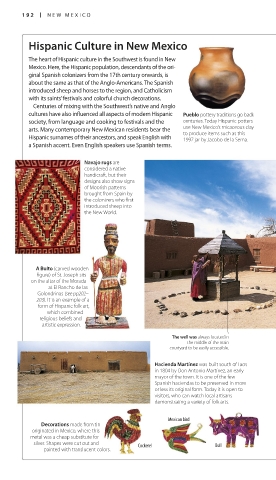
Hispanic Culture in New Mexico Hispanic culture, and there are many
Fiestas are an important element of
throughout the year, particularly on
The heart of Hispanic culture in the Southwest is found in New saints’ days (see pp36–9). Fiestas often
Mexico. Here, the Hispanic population, descendants of the ori combine both indigenous and Spanish
ginal Spanish colonizers from the 17th century onwards, is influences. Elements of Hispanic
celebrations have also been
about the same as that of the AngloAmericans. The Spanish incorporated into events in other
introduced sheep and horses to the region, and Catholicism cultures; here, young girls perform
with its saints’ festivals and colorful church decorations. traditional dances at celebrations
Centuries of mixing with the Southwest’s native and Anglo for the Fourth of July.
cultures have also influenced all aspects of modern His panic Pueblo pottery traditions go back
society, from language and cooking to festivals and the centuries. Today Hispanic potters
arts. Many contemporary New Mexican residents bear the use New Mexico’s micaceous clay Adobe beehive ovens (hornos)
to produce items such as this
His panic surnames of their ancestors, and speak English with 1997 jar by Jacobo de la Serna. were introduced by the Spanish
for baking bread. They were
a Spanish accent. Even English speakers use Spanish terms. originally of Moorish design.
Navajo rugs are Spanish Influence
considered a native
handicraft, but their The restored El Rancho de las Golondrinas
designs also show signs (see pp202–203) is a living museum
of Moorish patterns showing the way of life – centered on the
brought from Spain by hacienda – pioneered in the Southwest by
the colonizers who first the Spanish colonists. In a hacienda, a large
introduced sheep into number of rooms (approximately 20) would
the New World. be set around one or two courtyards,
reflecting the extended family style of living
favored by the Spanish settlers. The Spanish
Colonial style is also seen in the layout of
many towns, including central Santa Fe
(see pp196–9).
A Bulto (carved wooden
figure) of St. Joseph sits
on the altar of the Morada
at El Rancho de las
Golondrinas (see pp202–
203). It is an example of a
form of Hispanic folk art,
which combined
religious beliefs and
artistic expression.
The well was always located in
the middle of the main
courtyard to be easily accessible.
Hacienda Martínez was built south of Taos
in 1804 by Don Antonio Martínez, an early Chili ristras are
mayor of the town. It is one of the few garlands of dried
Spanish haciendas to be preserved in more red chilies sold as
or less its original form. Today it is open to souvenirs in New
visitors, who can watch local artisans Mexico. Chilis were
demonstrating a variety of folk arts. a Native American
food, unknown in
Europe before
Mexican bird Columbus landed Luminarias fill the square outside San Felipe de
Decorations made from tin in the Americas in Neri church in Albuquerque’s Old Town. These
originated in Mexico, where this 1492. However, Mexican lanterns (also called farolitos) consist of
metal was a cheap substitute for they were adopted a candle set in sand in a paper bag, and are
silver. Shapes were cut out and Cockerel Bull wholeheartedly displayed during religious festivals.
painted with translucent colors. by the Spanish.
192-193_EW_SW_USA.indd 192 28/11/17 12:42 PM 192-193_EW_SW_USA.indd 193 28/11/17 12:42 PM
Eyewitness Travel LAYERS PRINTED:
Feature template “UK” LAYER
(SourceReport v1.3)
Date 18th October 2012
Size 125mm x 217mm

