


Page 195 - (DK Eyewitness) Travel Guide - Southwest USA & National Parks
P. 195
INTRODUCING NE W MEXIC O 193
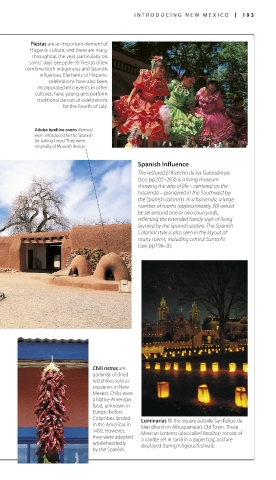
Fiestas are an important element of
Hispanic culture, and there are many
throughout the year, particularly on
saints’ days (see pp36–9). Fiestas often
combine both indigenous and Spanish
influences. Elements of Hispanic
celebrations have also been
incorporated into events in other
cultures; here, young girls perform
traditional dances at celebrations
for the Fourth of July.
Adobe beehive ovens (hornos)
were introduced by the Spanish
for baking bread. They were
originally of Moorish design.
Spanish Influence
The restored El Rancho de las Golondrinas
(see pp202–203) is a living museum
showing the way of life – centered on the
hacienda – pioneered in the Southwest by
the Spanish colonists. In a hacienda, a large
number of rooms (approximately 20) would
be set around one or two courtyards,
reflecting the extended family style of living
favored by the Spanish settlers. The Spanish
Colonial style is also seen in the layout of
many towns, including central Santa Fe
(see pp196–9).
Chili ristras are
garlands of dried
red chilies sold as
souvenirs in New
Mexico. Chilis were
a Native American
food, unknown in
Europe before
Columbus landed Luminarias fill the square outside San Felipe de
in the Americas in Neri church in Albuquerque’s Old Town. These
1492. However, Mexican lanterns (also called farolitos) consist of
they were adopted a candle set in sand in a paper bag, and are
wholeheartedly displayed during religious festivals.
by the Spanish.
192-193_EW_SW_USA.indd 193 28/11/17 12:42 PM

