


Page 54 - All About History - Issue 54-17
P. 54
Little Ships, Great Escape


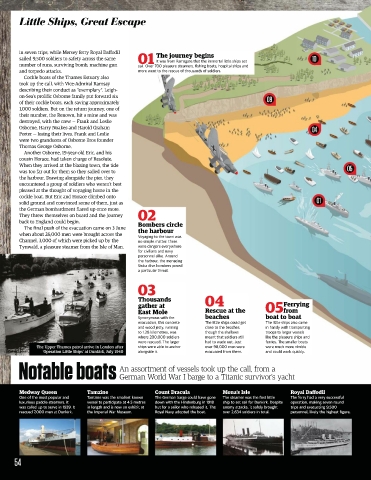
        in seven trips, while Mersey ferry Royal Daffodil   The journey begins
        sailed 9,500 soldiers to safety across the same   01  It was from Ramsgate that the immortal little ships set   10
        number of runs, surviving bomb, machine gun   sail. Over 700 pleasure steamers, fishing boats, hospital ships and
        and torpedo attacks.                      more went to the rescue of thousands of soldiers.
          Cockle boats of the Thames Estuary also
        took up the call, with Vice-Admiral Ramsay
        describing their conduct as “exemplary”. Leigh-
        on-Sea’s prolific Osborne family put forward six                                       08
        of their cockle boats, each saving approximately
        1,000 soldiers. But on the return journey, one of
        their number, the Renown, hit a mine and was
        destroyed, with the crew — Frank and Leslie
        Osborne, Harry Noakes and Harold Graham                                                                04
        Porter — losing their lives. Frank and Leslie
        were two grandsons of Osborne Bros founder
        Thomas George Osborne.
          Another Osborne, 19-year-old Eric, and his
        cousin Horace, had taken charge of Resolute.
        When they arrived at the blazing town, the tide                                                                    05
        was too far out for them so they sailed over to
        the harbour. Drawing alongside the pier, they
        encountered a group of soldiers who weren’t best
        pleased at the thought of voyaging home in the
        cockle boat. But Eric and Horace climbed onto                                                           01
        solid ground and convinced some of them, just as
        the German bombardment flared up once more.
        They threw themselves on board and the journey   02
        back to England could begin.              Bombers circle
          The final push of the evacuation came on 3 June   the harbour
        when about 26,000 men were brought across the
                                                  Voyaging to the town was
        Channel, 3,000 of which were picked up by the   no simple matter: there
        Tynwald, a pleasure steamer from the Isle of Man.  were dangers everywhere
                                                  for civilians and navy
                                                  personnel alike. Around
                                                  the harbour, the menacing
                                                  Stuka dive bombers posed
                                                  a particular threat.

                                                 03

                                                  Thousands              04
                                                  gather at                                          Ferrying
                                                  East Mole              Rescue at the        05from
                                                  Synonymous with the    beaches              boat to boat
                                                  evacuation, this concrete   The little ships could get   The little ships also came
                                                  and wood jetty, running   close to the beaches,   in handy with transporting
                                                  to 1.28 kilometres, was   though the shallows   troops to larger vessels
                                                  where 200,000 soldiers   meant that soldiers still   like the pleasure ships and
                                                  were rescued. The larger   had to wade out. Just   ferries. The smaller boats
              The Upper Thames patrol arrive in London after   ships were able to anchor   over 98,000 men were   were much more nimble
                ‘Operation Little Ships’ at Dunkirk, July 1940  alongside it.  evacuated from them.  and could work quickly.

                                           An assortment of vessels took up the call, from a
        Notable boats German World War I barge to a Titanic survivor’s yacht


        Medway Queen            Tamzine                Count Dracula           Mona’s Isle             Royal Daffodil
        One of the most popular and   Tamzine was the smallest known   The German barge could have gone   The steamer was the first little   The ferry had a very successful
        luxurious paddle steamers, it   vessel to participate at 4.5 metres   down with the Hindenburg in 1918   ship to set sail for Dunkirk. Despite   operation, making seven round
        was called up to serve in 1939. It   in length and is now an exhibit at   but for a sailor who released it. The   enemy attacks, it safely brought   trips and evacuating 9,500
        rescued 7,000 men at Dunkirk.  the Imperial War Museum.  Royal Navy adopted the boat.  over 2,634 soldiers in total.  personnel, likely the highest figure.


      54

