


Page 56 - All About History - Issue 54-17
P. 56
Little Ships, Great Escape


          Operation Dynamo formally wrapped up at   The New York Times on 1 June 1940. “In that
        2.33pm on 4 June. Thousands of French and   harbour, such a hell on earth as never blazed
        British soldiers had courageously attempted to hold  before, at the end of a lost battle, the rags and
        off the Germans to ensure their comrades’ escapes.   blemishes that had hidden the soul of democracy
        The biggest evacuation in military history had   fell away. There, unbeaten but unconquered, in
        seen some 338,000 soldiers rescued — 200,000   shining splendour, she faced the enemy, this
        from the East Mole — with the evacuees including   shining thing in the souls of free men, which
        140,000 French, Belgian and Polish troops. More   Hitler cannot command. It is in the great tradition
        than 200 ships and boats were destroyed and   of democracy. It is a future. It is victory.”
                                                                                          Fighting on
        40,000 of Britain’s soldiers were left behind    But perhaps the most famous commentary is
        and became prisoners of war.           contained in novelist and playwright JB Priestley’s
          The now famous little ships proceeded through   celebrated Postscripts radio broadcasts for the BBC.
        London on 9 June and were greeted by huge   “Here at Dunkirk is another English epic. And to  the beaches
        crowds and much cheering when they arrived at   my mind what was most characteristically English
        Westminster Bridge. Many of the boats resumed   about it — so typical, so absurd and yet so grand   Journalist Hugh Sebag-
        life as it was before Dunkirk but some, sadly, could   and gallant that you hardly knew whether to laugh   Montefiore thinks the soldiers
        not be preserved. The Association of Dunkirk Little   or cry when you read about them — was the part   who kept the Germans at bay
        Ships emerged and 39 of them were the main   played in the difficult and dangerous embarkation
        attraction of the Queen’s Diamond Jubilee    — not by the warships, magnificent though they   during the rescue mission
        pageant in 2012.                       were — but by the little pleasure steamers,” he said.  deserve more credit
          The same day Operation Dynamo concluded,   “We’ve known them, and laughed at them,
        Winston Churchill took to the House of   these fussy little steamers, all our lives. We have   Your book centres on the
                                                                                                       soldiers who defended the
        Commons  for his barnstorming ‘We Shall Fight   watched them load and unload their crowds of
                                                                                                       retreat route. How would you
        on the Beaches’ speech. While these days it is   holiday passengers — the gents full of high spirits   describe their contribution?
        remembered for rousing British morale, and did   and bottled beer, the ladies eating pork pies, the   Well, what I’d say is if it hadn’t been
                                                                                                       for them the evacuation would
        commend the efforts of the little ships and the   children sticky with peppermint rock...
                                                                                                       have been stopped. It would have
        armed forces alike, the Prime Minister actually   “There was always something old-fashioned,    started, but it might well have been
        warned against celebrating the evacuations too   a Dickens touch, a mid-Victorian air about them…   stopped after the first night. That’s
        merrily: “We must be very careful not to assign to   Yes, those ‘Brighton Belles’ and ‘Brighton Queens’   the answer in a nutshell.
        this deliverance the attributes of a victory. Wars are   left that innocent foolish world of theirs… to sail   Were there any stories that particularly resonated?
        not won by evacuations.”               into the inferno, to defy bombs, shells, magnetic   What I found amazing was what happened at Cassel,
          But the mythologising of the operation, both   mines. I tell you, we were proud of the Gracie   involving a man called Roy Creswell. The British soldiers
                                                                                          were locked up in a blockhouse. Germans were on the
        here and across the Atlantic, had already begun.   Fields… This little steamer, like all her brave and
                                                                                          roof, they were throwing things down the chimney, they
        “So long as the English tongue survives, the word   battered sisters, is immortal — she’ll go sailing   set it on fire with hand grenades and still Creswell’s men
        Dunkirk will be spoken with reverence,” reported   proudly down the years in the epic of Dunkirk.”  held out for four or five days. They lasted out until 30 May
                                                                                          when they surrendered, but it’s an inspiring story.
                                                                                          Has there been enough emphasis on these soldiers,
           “The now famous little ships proceeded through London on                       or do you think they have been almost forgotten?
                                                                                          Yes, they have been forgotten, but that’s not to say that
          9 June and were greeted by huge crowds and much cheering                        the little ships weren’t vital — it wouldn’t have succeeded
                                                                                          without them and the Royal Navy and everything else;
                      when they arrived at Westminster Bridge”                            they all came together.
                                                                                          Why do you think the story of the little ships (and
                                                                                          Dunkirk in general) has become so mythologised?
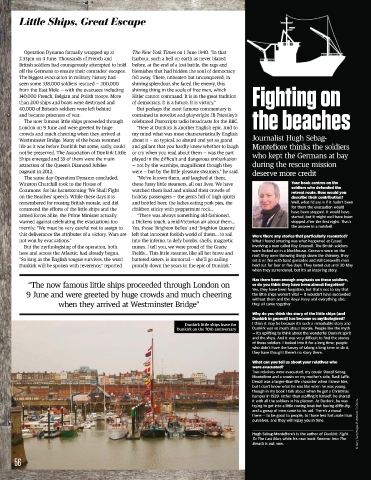
                                                                  Dunkirk little ships leave for   I think it may be because it’s such a remarkable story and
                                                               Dunkirk on the 70th anniversary  Dunkirk was so much about morale. People like the myth
                                                                                          — it’s uplifting to think about the wonderful Dunkirk spirit
                                                                                          and the ships. And it was very difficult to find the stories
                                                                                          of these soldiers. I looked into it for a long time; people
                                                                                          who didn’t have the luxury of taking a long time to do it,
                                                                                          they have thought there’s no story there.
                                                                                          What can you tell us about your relatives who
                                                                                          were evacuated?
                                                                                          Two relatives were evacuated, my cousin Denzil Sebag-
                                                                                          Montefiore and a cousin on my mother’s side, Basil Jaffé.
                                                                                          Denzil was a larger-than-life character when I knew him,
                                                                                          but I don’t know what he was like when he was young,
                                                                                          though in my book I talk about when he got a Christmas
                                                                                          hamper in 1939: rather than scoffing it himself, he shared
                                                                                          it with all the soldiers in his platoon. At Dunkirk, he was
                                                                                          trying to get into a little rowing boat but having difficulty,
                                                                                          and a group of men came to his aid. There’s a moral
                                                                                          there — to be good to people, to those less fortunate than
                                                                                          ourselves, and they will repay you in time.   © Alamy, Getty Images, Shutterstock, Ed Crooks.

                                                                                          Hugh Sebag-Montefiore’s is the author of Dunkirk: Fight
                                                                                          To The Last Man, while his new book Somme: Into The
                                                                                          Breach is out now.

      56

