


Page 52 - All About History - Issue 54-17
P. 52
Little Ships, Great Escape


             ritain was on the brink in spring 1940.
             The Nazi war machine had swept through
             Holland, Belgium and Luxembourg and
             was making gains in France fast. The
       B British Expeditionary Force (BEF) and their
        French counterparts began a hasty retreat close
        to the coastal town of Dunkirk where thousands
        would fight to the death to give their comrades the
        best chance of escape.
          It seemed all was lost and the BEF consigned to
        total defeat, but they didn’t count on the armada of
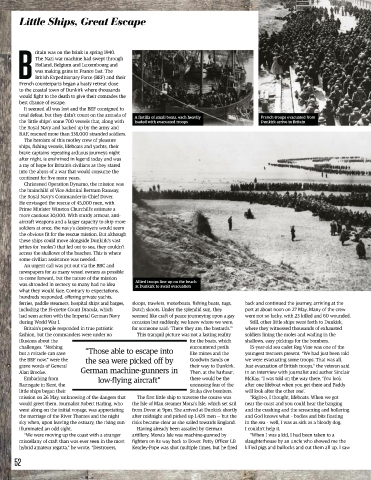
                                                A flotilla of small boats, each heavily      French troops evacuated from
        the ‘little ships’: some 700 vessels that, along with   loaded with evacuated troops  Dunkirk arrive in Britain
        the Royal Navy and backed up by the army and
        RAF, rescued more than 338,000 stranded soldiers.
          The heroism of this motley crew of pleasure
        ships, fishing vessels, lifeboats and yachts, their
        brave captains repeating arduous journeys night
        after night, is enshrined in legend today and was
        a ray of hope for Britain’s civilians as they stared
        into the abyss of a war that would consume the
        continent for five more years.
          Christened Operation Dynamo, the mission was
        the brainchild of Vice-Admiral Bertram Ramsay,
        the Royal Navy’s Commander-in-Chief Dover.
        He envisaged the rescue of 45,000 men, with
        Prime Minister Winston Churchill’s estimate a
        more cautious 30,000. With sturdy armour, anti-
        aircraft weapons and a larger capacity to ship more
        soldiers at once, the navy’s destroyers would seem
        the obvious fit for the rescue mission. But although
        these ships could move alongside Dunkirk’s vast
        jetties (or ‘moles’) that led out to sea, they couldn’t
        access the shallows of the beaches. This is where
        some civilian assistance was needed.
          An urgent call was put out via the BBC and
        newspapers for as many vessel owners as possible
        to come forward, but the nature of the mission
                                                 Allied troops line up on the beach
        was shrouded in secrecy so many had no idea   at Dunkirk to await evacuation
        what they would face. Contrary to expectations,
        hundreds responded, offering private yachts,
        ferries, paddle steamers, hospital ships and barges,   sloops, trawlers, motorboats, fishing boats, tugs,   back and continued the journey, arriving at the
        including the 15-metre Count Dracula, which    Dutch skoots. Under the splendid sun, they   port at about noon on 27 May. Many of the crew
        had seen action with the Imperial German Navy    seemed like craft of peace journeying upon a gay   were not so lucky, with 23 killed and 60 wounded.
        during World War I.                    occasion but suddenly, we knew where we were,   Still, other little ships went forth to Dunkirk,
          Britain’s people responded in true patriotic   for someone said: ‘There they are, the bastards.’”  where they witnessed thousands of exhausted
        fashion, but the commanders were under no   This tranquil picture was not a lasting reality   soldiers lining the moles and wading in the
        illusions about the                                         for the boats, which   shallows, easy pickings for the bombers.
        challenges. “Nothing                                        encountered perils   15-year-old sea cadet Reg Vine was one of the
        but a miracle can save   “Those able to escape into         like mines and the   youngest rescuers present. “We had just been told
        the BEF now,” were the   the sea were picked off by         Goodwin Sands on   we were evacuating some troops. That was all.
        grave words of General                                      their way to Dunkirk.   Just evacuation of British troops,” the veteran said
        Alan Brooke.         German machine-gunners in              Then, at the harbour,   in an interview with journalist and author Sinclair
          Embarking from            low-flying aircraft”            there would be the   McKay. “I was told on the way there, ‘You look
        Ramsgate in Kent, the                                       unceasing fear of the   after one lifeboat when you get there and Paddy
        little ships began their                                    Stuka dive bombers.  will look after the other one’.
        mission on 26 May, unknowing of the dangers that   The first little ship to traverse the course was   “Right-o, I thought, lifeboats. When we got
        would greet them. Journalist Robert Harling, who   the Isle of Man steamer Mona’s Isle, which set sail   near the coast and you could hear the banging
        went along on the initial voyage, was appreciating   from Dover at 9pm. She arrived at Dunkirk shortly   and the crashing and the screaming and hollering
        the marriage of the River Thames and the night   after midnight and picked up 1,429 men — but the   and God knows what – bodies and bits floating
        sky when, upon leaving the estuary, the rising sun   risks became clear as she sailed towards England.  in the sea – well, I was as sick as a bloody dog.
        illuminated an odd sight.                Having already been assailed by German   I couldn’t help it.
          “We were moving up the coast with a stranger   artillery, Mona’s Isle was machine-gunned by   “When I was a kid, I had been taken to a
        miscellany of craft than was ever seen in the most   fighters on its way back to Dover. Petty Officer LB   slaughterhouse by an uncle who showed me the
        hybrid amateur regatta,” he wrote. “Destroyers,   Kearley-Pope was shot multiple times, but he fired   killed pigs and bullocks and cut them all up. I saw
      52

