


Page 14 - Time Special Edition Alternative Medicine (January 2020)
P. 14
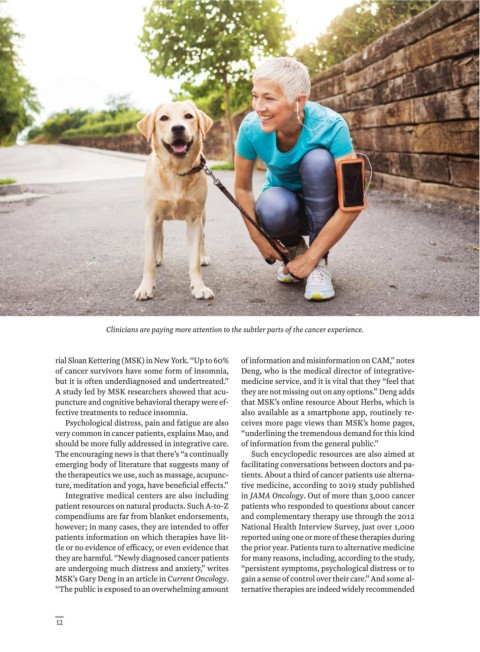
Clinicians are paying more attention to the subtler parts of the cancer experience.


                   rial Sloan Kettering (MSK) in New York. “Up to 60%           of information and misinformation on CAM,” notes
                   of cancer survivors have some form of insomnia,              Deng, who is the medical director of integrative-
                   but it is often underdiagnosed and undertreated.”            medicine service, and it is vital that they “feel that

                   A study led by MSK researchers showed that acu-              they are not missing out on any options.” Deng adds
                   puncture and cognitive behavioral therapy were ef-           that MSK’s online resource About Herbs, which is
                   fective treatments to reduce insomnia.                       also available as a smartphone app, routinely re-
                      Psychological distress, pain and fatigue are also         ceives more page views than MSK’s home pages,
                   very common in cancer patients, explains Mao, and            “underlining the tremendous demand for this kind
                   should be more fully addressed in integrative care.          of information from the general public.”
                   The encouraging news is that there’s “a continually             Such encyclopedic resources are also aimed at
                   emerging body of literature that suggests many of            facilitating conversations between doctors and pa-
                   the therapeutics we use, such as massage, acupunc-           tients. About a third of cancer patients use alterna-

                   ture, meditation and yoga, have beneficial effects.”         tive medicine, according to 2019 study published
                      Integrative   medical   centers  are  also  including     in JAMA Oncology. Out of more than 3,000 cancer
                   patient resources on natural products. Such A-to-Z           patients who responded to questions about cancer
                   compendiums are far from blanket endorsements,               and complementary therapy use through the 2012
                   however; in many cases, they are intended to offer           National Health Interview Survey, just over 1,000
                   patients information on which therapies have lit-            reported using one or more of these therapies during
                   tle or no evidence of efficacy, or even evidence that        the prior year. Patients turn to alternative medicine

                   they are harmful. “Newly diagnosed cancer patients           for many reasons, including, according to the study,
                   are undergoing much distress and anxiety,” writes            “persistent symptoms, psychological distress or to
                   MSK’s Gary Deng in an article in Current Oncology.           gain a sense of control over their care.” And some al-
                   “The public is exposed to an overwhelming amount             ternative therapies are indeed widely recommended


                   12

