


Page 15 - Time Special Edition Alternative Medicine (January 2020)
P. 15
by oncologists. Mind-body interventions like yoga,           Insomnia, psychological
                      tai chi, meditation and mindfulness, which were
                      each used by about 7% of patients, can keep peo- distress, pain and

                      ple fit and energetic as they undergo treatment, re-         fatigue are common
                      duce the side effects of traditional therapies, lessen
                      stress and improve mental health. Cancer patients            complications for
                      who were more likely to use complementary thera-             cancer patients. The
                      pies, noted the study, were young, white and female.         encouraging news is that

                          But the problem, according to the study, was that
                      about a third of these patients did not tell their doc-      a range of alternative
                      tors that they were using alternative therapies. Why         therapies can help.
                      not? In many cases, explained the survey respon-
                      dents, either their doctors did not ask or they did not
                      think their doctors needed to know. That’s a poten-
                      tially risky oversight. Some herbal supplements may

                      interact in unforeseen ways with conventional treat-           aromatase inhibitors—medications recommended
                      ments such as chemotherapy and radiation. High               for up to 10 years to protect against a recurrence of
                      levels of antioxidants can interfere with radiation,         the disease. But these drugs can produce side ef-
                      for example, and herbal supplements can become               fects, including severe joint pain, which cause many
                      dangerous when mixed with certain prescription               women to stop taking them. Patients may now have
                      drugs. This is the reason, according to the study’s          another option they can discuss with doctors. Re-
                      lead author, Nina Sanford, of the University of Texas        search presented at the 2017 San Antonio Breast
                      Southwestern Medical Center, that it is paramount            Cancer Symposium suggests that acupuncture may
                      for cancer patients to discuss such use of supple-           reduce drug-related joint pain for such women and

                      ments with their doctors.                                    may provide a way for them to continue taking these
                          The  benefits   of  communication      can  also  ex-    potentially lifesaving medications.
                      tend to side effects that are well known and seem-               “Aromatase inhibitors are one of the most com-
                      ingly unavoidable. Every year, for instance, tens of         mon and most effective medications in breast can-
                      thousands of breast-cancer patients are prescribed           cer, and they’re used for both prevention and for
                                                                                   early-stage   treatment,”    says  lead  author   Dawn

                                                                                     Hershman, professor of medicine and epidemiol-
                                                                                   ogy at Columbia University and vice chair of the re-
                                                                                   search network that conducted the study. “But we
                                                                                   know that they don’t work if people don’t take them,
                                                                                   and we know the most common reason people don’t
                                                                                   take them is because they develop side effects.”
                                                                                       The  cancer-fighting    medicines   are  commonly
                                                                                   prescribed     to  postmenopausal        women      with
                                                                                     hormone-sensitive breast cancers, sometimes for

                                                                                   up  to  10  years.  (About  80%   of  all  breast  cancers
                                                                                   are  hormone-sensitive,      also  known    as  estrogen
                                                                                     receptor–positive.) But about half of the women
                                                                                   who   take  aromatase    inhibitors  report   joint  pain
                                                                                   and stiffness that affect the knees, hips, hands and
                                                                                   wrists. The pain can be so severe that it makes it
                                                                                   difficult for women to walk, sit, climb stairs, type

                                                                                   or drive a vehicle. Researchers even have a name
                                                                                   for the condition: aromatase inhibitor–associated
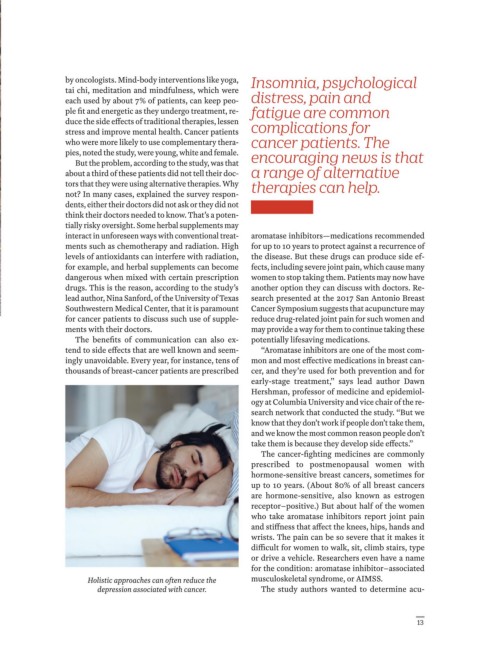
                              Holistic approaches can often reduce the             musculoskeletal syndrome, or AIMSS.
                                 depression associated with cancer.                    The  study  authors   wanted    to  determine   acu-


                                                                                                                                          13

